


BLDC vs FOC ESCs for UAVs: Control and Selection Guide
BLDC vs FOC ESCs for UAVs: Which One Fits Your Platform?
BLDC and FOC are control approaches, not universal quality labels. BLDC uses timed commutation; field-oriented control regulates the motor field with feedback. The right choice depends on motor, propeller, noise target, voltage class, tuning access and order volume.
Related resources: UAV motors, OEM support, and contact REACHSKY.
How they differ
BLDC control is familiar and widely deployed. FOC can reduce torque ripple and acoustic noise when motor feedback, current measurement and parameters are suitable. FOC may require tighter motor, firmware and system integration.
What to verify before buying
- Exact voltage and continuous current rating
- Motor KV, electrical characteristics and feedback
- Signal protocol, telemetry and firmware access
- Cooling, enclosure and replacement strategy
SKU rule: never generalize a product family’s voltage or current range to every model.
BLDC control in a practical UAV build
BLDC ESCs are often selected for established platforms because the motor, firmware and flight-controller signal path are already known. This can simplify fleet replacement and technician training. It does not remove the need to check timing, ramp rate, current limits, cooling and the propeller load at the intended voltage.
For a new platform, request the test conditions behind the quoted current and efficiency figures. A continuous current number without duration, airflow, temperature and mounting context is difficult to compare across suppliers.
What FOC adds to the integration task
FOC uses current and rotor-position information to regulate the motor field. The potential benefits include smoother torque delivery and lower acoustic noise, particularly in operating regions where commutation ripple matters. The integration work may be higher because the controller needs suitable motor data, feedback and parameter settings.
Voltage, current and cooling are separate checks
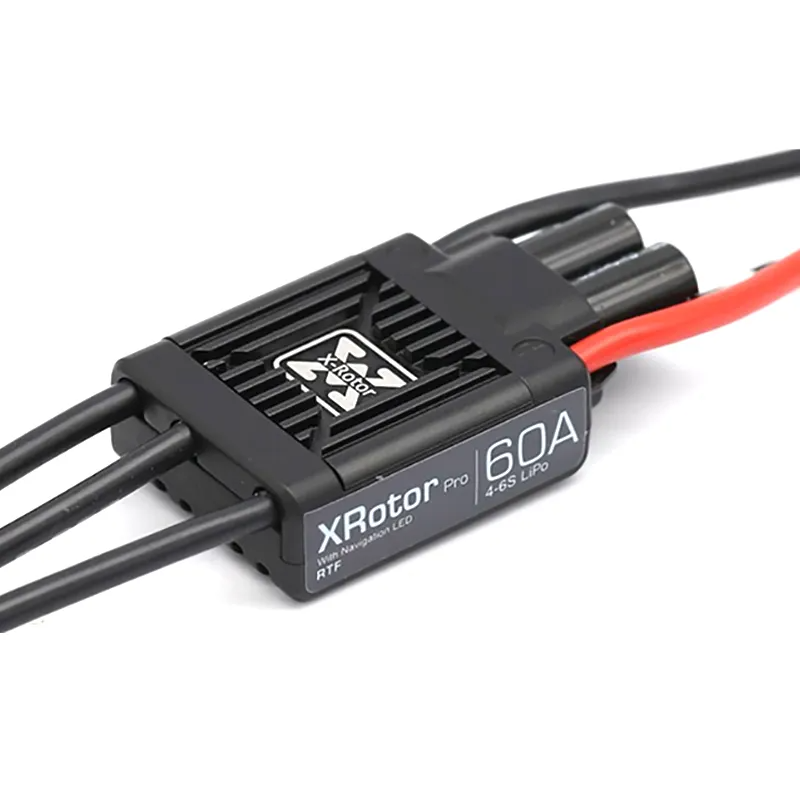
Do not use a high voltage label as a substitute for a current or thermal review. The pack voltage, phase current, switching losses, airflow, heat-sink contact and enclosure all influence the real operating limit. Ask for the exact model’s continuous and burst definitions and confirm how the ESC is mounted in the airframe.
Firmware and service questions for buyers
- Which signal protocols and telemetry functions are supported?
- Can firmware be updated in the field, and how are versions recorded?
- What motor feedback or sensor arrangement is required?
- What protection events are logged during a fault?
- Can the supplier provide a repeatable configuration for replacement units?
How to compare samples fairly
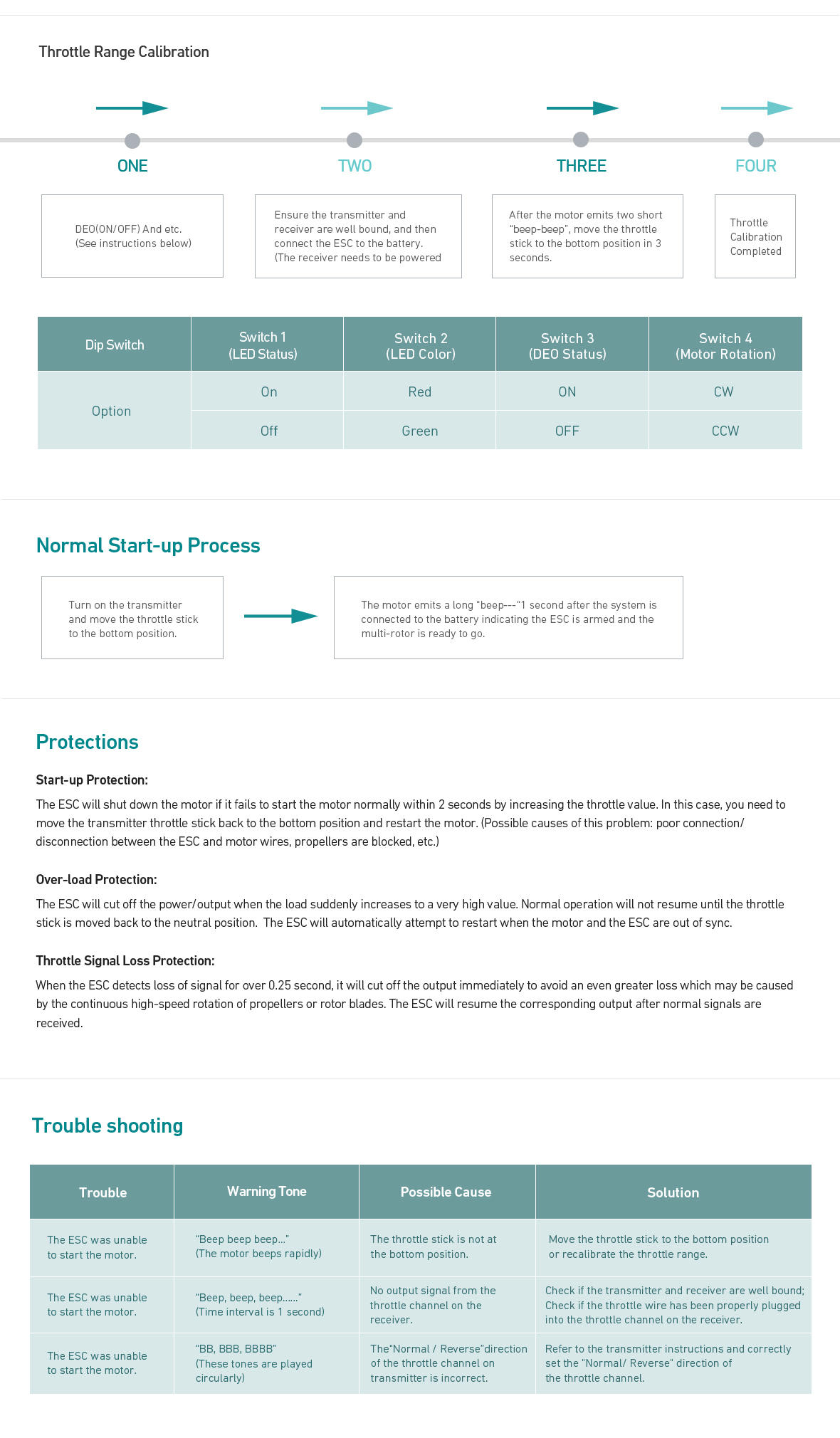
Use the same motor, propeller, battery, throttle points and cooling conditions for both samples. Record current, temperature, noise and telemetry behavior. A short bench test cannot prove long-term reliability, but it can expose an obvious mismatch before the product enters a fleet.
Noise, vibration and camera payloads
Noise and torque ripple matter when the UAV carries a camera, microphone or other sensitive payload. FOC may be worth evaluating when the platform needs smoother torque delivery, but the result still depends on motor geometry, propeller balance, firmware tuning and the mechanical frame. A control label alone cannot predict the final acoustic result.
For a fair comparison, measure both samples at the same thrust and pack voltage. Record motor temperature, ESC temperature, current, sound level and any telemetry alarms. If the platform has a closed enclosure, repeat the test with representative airflow.
Current ratings need test conditions
Continuous and burst current are different operating claims. Ask how long the burst lasts, what temperature is allowed, whether the rating is phase or battery current, and how the ESC is cooled. These questions prevent a catalogue number from being applied to a different installation.
When a simpler BLDC solution is the better choice
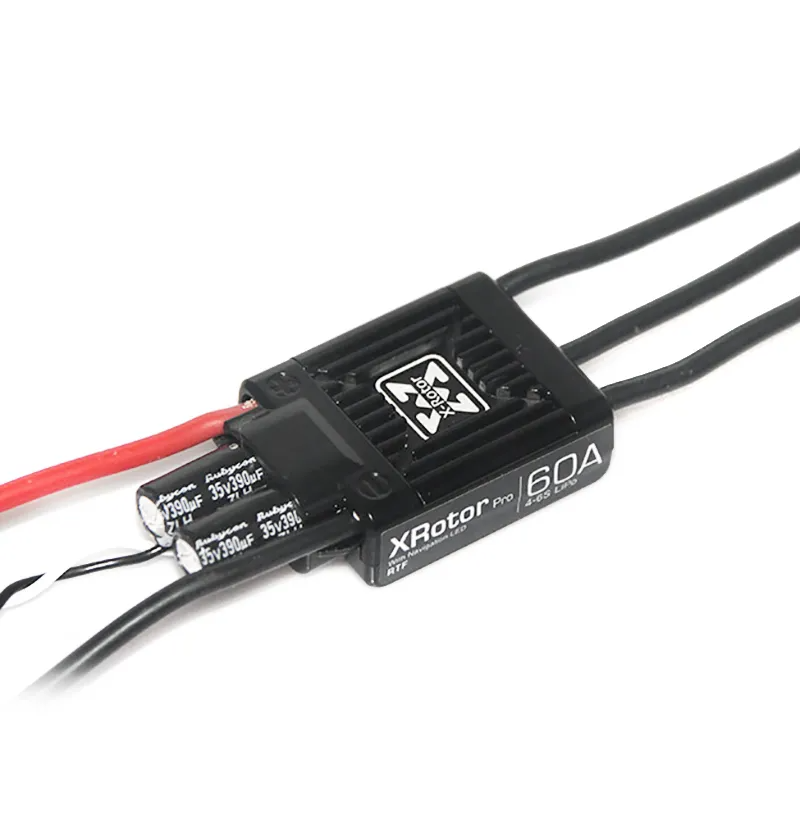
A proven BLDC setup can be the better commercial option when the platform already has stable firmware, known motor data and an established replacement stock. It can shorten technician training and reduce configuration changes across a fleet. The choice should follow the platform’s service and documentation requirements, not a generic preference for one control method.
What a supplier should provide for evaluation
Ask for the exact model name, voltage and current definitions, signal and telemetry protocol, firmware version, wiring diagram, cooling assumptions and recommended motor range. For FOC, request the motor data or parameter process required for commissioning. For BLDC, confirm timing, ramp and protection settings. These details make a sample test repeatable and reduce avoidable integration work.
For a multi-unit order, also confirm how replacement units are identified and whether firmware or configuration files are retained with the batch record.
Comparison checklist for an RFQ
A useful request for quotation separates the control architecture from the commercial requirements. State the motor model, pack voltage, propeller, expected continuous current, expected peak current, signal protocol and cooling arrangement. Then ask the supplier to identify the exact ESC SKU, firmware family and test conditions behind the quoted limits.
This information helps a buyer compare a familiar BLDC unit with an FOC unit without assuming that a larger current number or a newer label automatically represents a better fit. It also makes replacement planning easier because the fleet record contains the configuration details needed by a technician.
Integration risks to review early
- Signal or telemetry incompatibility with the flight controller.
- Motor feedback requirements that are missing from the airframe wiring.
- Different meanings of continuous and burst current between suppliers.
- Insufficient airflow inside a fairing or sealed arm.
- Firmware changes between sample and repeat production.
For a new platform, a short, documented bench comparison is more useful than a broad claim about BLDC or FOC. Record the same motor, propeller, battery, throttle points and thermal conditions for both samples. For an established fleet, serviceability and repeatable configuration may outweigh a theoretical efficiency difference. Buyers can discuss a matched configuration through Reachsky’s OEM inquiry route.
First separate the motor from the control method
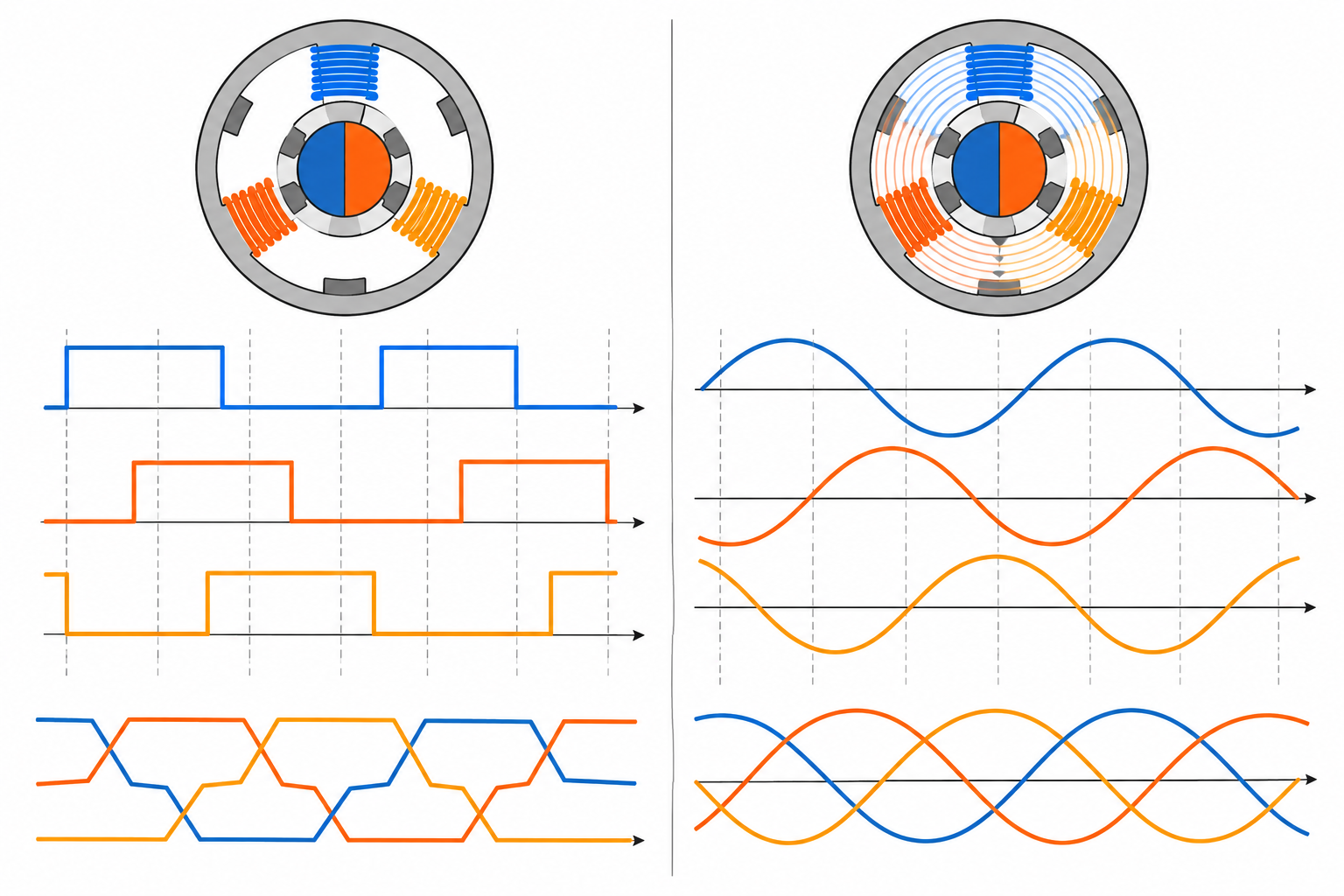
BLDC usually describes a brushless permanent-magnet motor and, in ESC discussions, a conventional commutation approach. FOC, or field-oriented control, describes how the controller regulates the motor currents and electrical field. An FOC ESC can therefore drive a BLDC-type motor; the terms are not two mutually exclusive motor families.
This distinction matters in a UAV RFQ. A buyer should specify the motor, feedback arrangement, signal protocol and control requirements instead of asking for “a BLDC motor or an FOC motor” as if those labels were interchangeable products.
What conventional BLDC commutation provides
Trapezoidal or six-step commutation is widely used because it is familiar, practical and available across many propulsion systems. Its behavior depends on timing, ramp rate, motor back-EMF, switching devices, firmware and load. A proven BLDC setup can be attractive for a fleet when the motor, propeller, firmware and replacement process are already stable.
What FOC changes
FOC regulates the electrical field using measured current and rotor-position information. With a suitable motor and correct tuning, it can reduce torque ripple and audible noise in relevant operating regions. It can also increase integration requirements: the controller needs compatible feedback, parameters, firmware and thermal design.
Do not publish unsupported efficiency percentages
Efficiency and noise are system results. They vary with motor inductance, propeller load, switching strategy, current, temperature, firmware and test method. Unless a supplier or test report identifies the conditions, do not turn a general comparison into a fixed percentage claim.
Selection matrix for UAV buyers
| Question | What to verify |
|---|---|
| Control | Commutation method, feedback and tuning process |
| Electrical | Exact voltage, continuous current and burst definition |
| Integration | Signal protocol, telemetry and firmware access |
| Thermal | Cooling path, mounting and enclosure assumptions |
| Service | Configuration records and replacement compatibility |
Sources and technical boundary
The T-Motor comparison discusses UAV ESC selection, while an Avnet BLDC control note explains the relationship between commutation methods and FOC. These sources support terminology; the exact voltage, current and firmware limits remain SKU-specific.
Preguntas frecuentes
Is FOC always more efficient?
No. Efficiency depends on motor, load, tuning, switching strategy, cooling and operating point.
Can an FOC ESC use any UAV motor?
No. Motor electrical characteristics and feedback requirements must match the ESC.
Which is easier to replace?
That depends on documentation, firmware compatibility and the spare strategy for the exact SKU.
Where can I review ESC options?
When a motor and ESC pair runs hot, work through the ESC overheating causes before swapping hardware.
If a build loses commutation under load, work the motor desync high current checklist before changing the control architecture.
Artículos relacionados
-
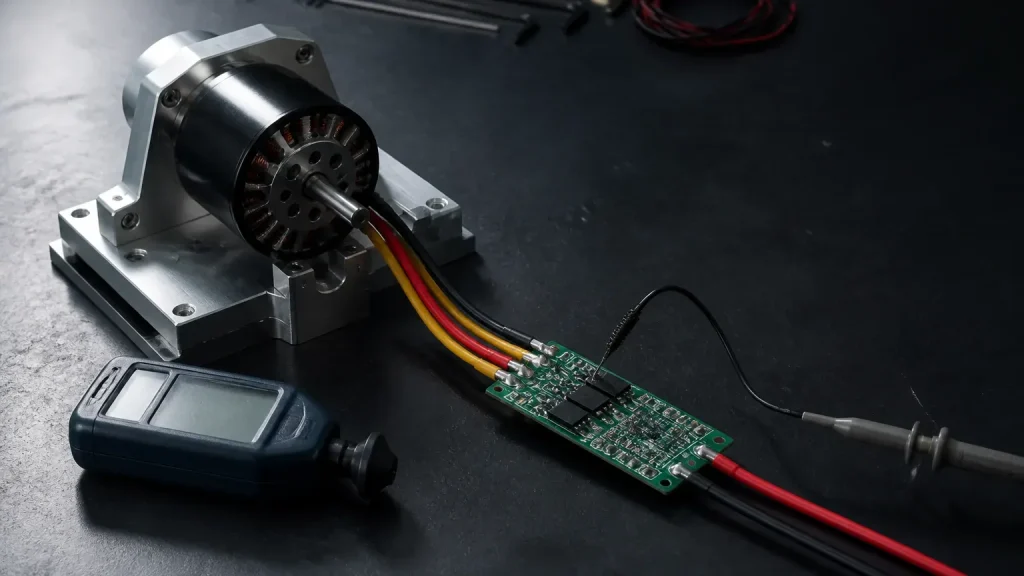 Motor Desync High Current: Causes and Fixes
Why a motor loses commutation exactly when current climbs, the six causes in the order worth checking, and a bench routine that makes desync repeatable.
-
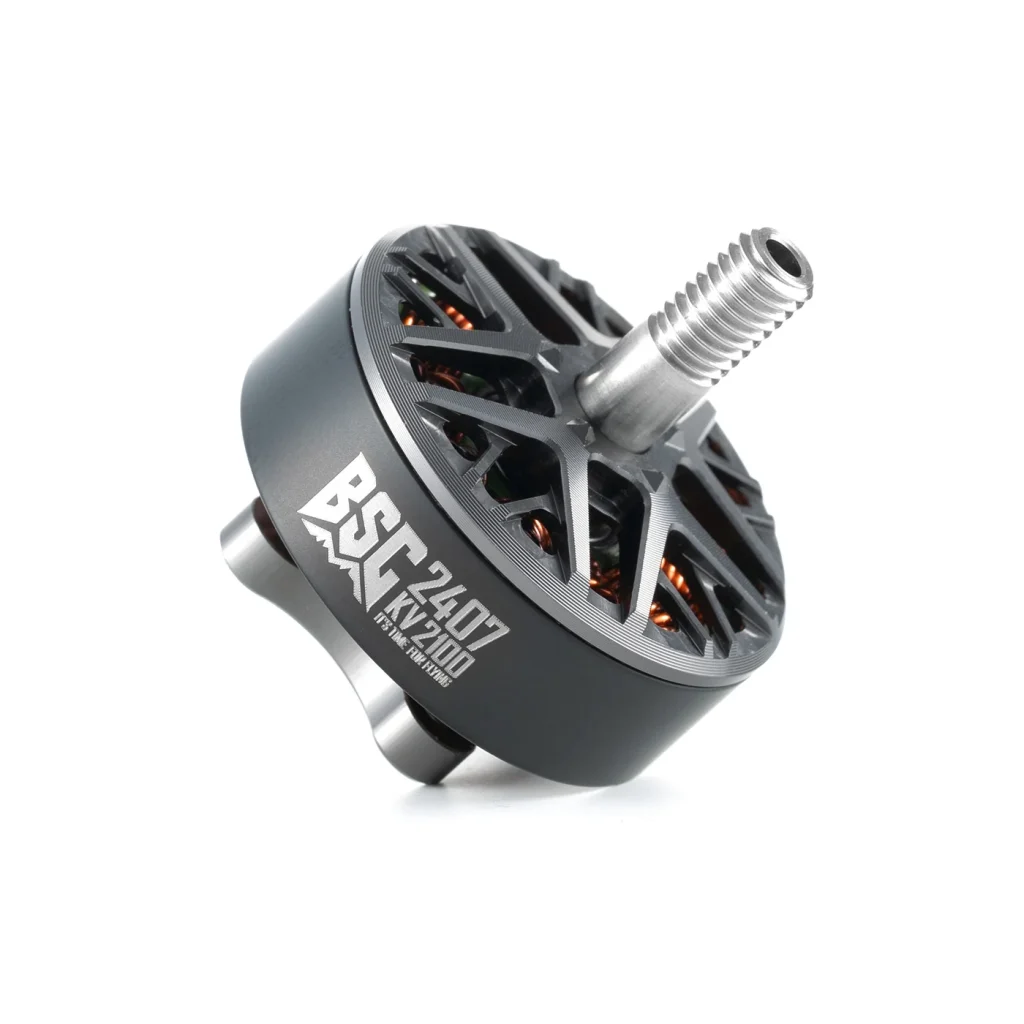 FPV Motor Series Explained: BSC, CM, FS and KONKER
A series name helps you find a motor. It does not finish the selection. ??inematic??is not a payload rating, ??reestyle??is not a battery specification, and ??asic??does not tell…
-
 Drone Motor Bearing Maintenance and Replacement Intervals
A motor that sounds different after a prop strike needs an inspection, even if it is far from its planned service date. A motor that sounds unchanged still…
-
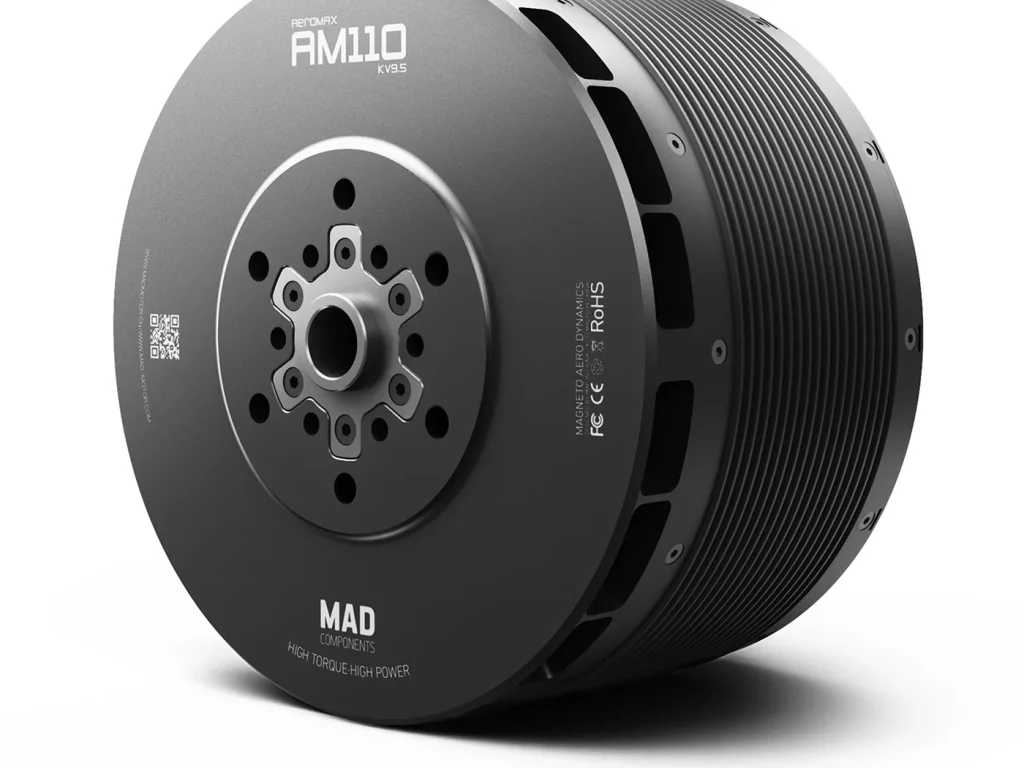 Heavy-Lift Drone Motor Selection: Payload, Thrust and Redundancy
A step-by-step heavy-lift drone motor selection method: payload to all-up weight, thrust per arm, redundancy reserve, then a datasheet check on the AM110.