

How to Read a Motor Thrust Table and Pick the Right Propeller
A common mistake is to read the last row of a drone motor thrust table, see enough thrust, and order the motor. That row may describe a load your aircraft uses only briefly. It says little about the current draw at hover or the temperature after a sustained run.
Start with the thrust your aircraft actually needs. Then read across the table at that operating point. The propeller choice follows from those rows, rather than from the biggest number on the page.
In short
- Work out the thrust your aircraft needs per rotor before you open any table: all-up mass divided by the number of rotors.
- Read thrust, current and input power at that operating point — not from the last row of the sheet.
- Test conditions are part of the data: motor variant, KV, propeller, ESC and supply voltage all have to match your build.
- Every figure below is quoted from a manufacturer’s published test table. It is source data, not a new test.
Before reading the drone motor thrust table, check the test setup
A thrust table describes a combination: motor variant, KV, propeller, ESC and supply voltage. Change one of them and the table may no longer describe your build.
Check the header before the numbers. Record the exact propeller diameter and pitch, blade count, motor KV and tested voltage. If the report identifies an ESC or firmware revision, keep that information with the data. A similar-looking propeller is not enough to establish an equivalent load.

The drone propeller catalog is useful for finding candidates. It is not a compatibility chart. Narrow the list by your frame clearance and mounting arrangement, then look for a test report covering the actual combination.
Keep a distinction between a static bench result and an installed aircraft result. The bench isolates one propulsion unit; the aircraft adds nearby arms, wiring, other rotors and a different operating environment. Use the table to shortlist a combination, then validate it on the build.
Find your required thrust before comparing propellers
For a conventional multirotor with equally loaded rotors, divide the all-up mass by the number of rotors to estimate the static hover requirement per rotor. All-up mass includes the battery and everything carried on the flight.
The REACHSKY technical FAQ gives a simple example: a 2 kg quadcopter needs approximately 0.5 kgf per rotor to balance its weight. That is a hover estimate, not a maximum-thrust target. The same FAQ suggests looking for that thrust in the 40–70% throttle region. Treat that range as initial selection guidance, not a universal flight-control requirement.
For an X8 or another coaxial arrangement, do not assume that two isolated-motor thrust values simply add together. Request data for the installed rotor arrangement. Aircraft balance and operating conditions also determine how evenly the motors share the load.
Now find the rows around your required thrust. Read the current and input power at those rows. Note where hover falls within the tested throttle range and what additional thrust remains available. A candidate that reaches the target only near its maximum tested output needs closer examination before you commit to it.
Read across the row: thrust, current and power
The most useful first pass is straightforward:
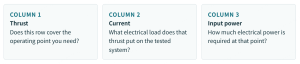
Throttle is a command setting. It is not a direct measure of thrust or power. Do not assume that 50% throttle produces half the maximum thrust, or that the same throttle percentage makes two propellers comparable. Compare them at the same required thrust and under matching test conditions.
Also check the units. A thrust column in grams or kilograms commonly represents gram-force or kilogram-force; it is not an SI force value in newtons. Keep units consistent when comparing reports.
Two different quantities may both be called efficiency. Thrust per input power, often expressed in g/W, tells you how much static thrust is obtained for the electrical input. Motor efficiency in percent compares mechanical output power with electrical input power. Those figures answer different questions. Neither alone predicts the flight time of a complete aircraft.
A real table: CM5330 with an 18×12 propeller
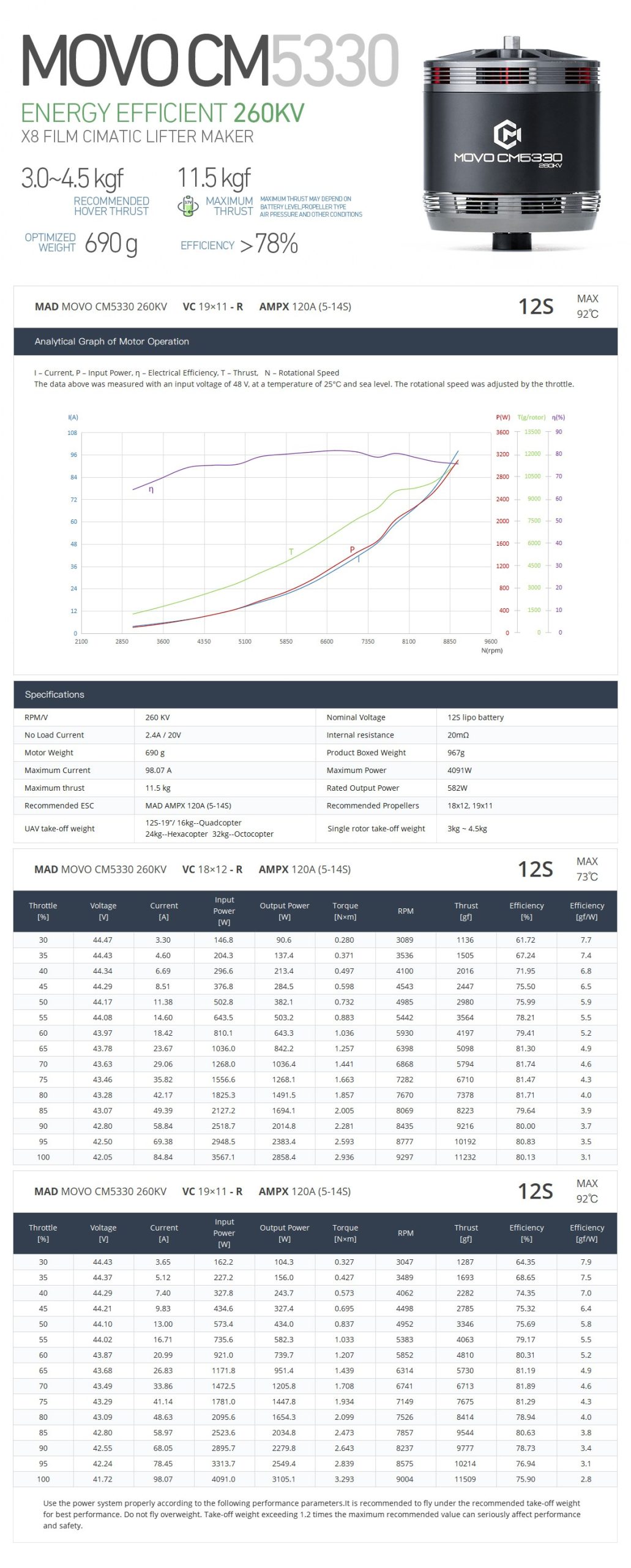
The local MAD MOVO CM5330 260KV product sheet includes a test table for a VC 18×12-R propeller and AMPX 120A (5–14S) ESC, under a 12S heading. Its measured voltage column changes with the operating point; use that column when checking input power rather than substituting a nominal pack voltage.
At 50% throttle, the table reports 2,980 gf of thrust, 11.38 A and 502.8 W of input power. At 55%, it reports 3,564 gf, 14.60 A and 643.5 W. For a required thrust of about 3 kgf per rotor, these rows bracket the target. The second row is not merely “5% more power”: it represents a different measured thrust and electrical load.
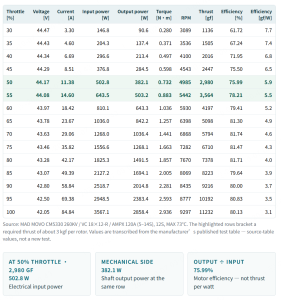
The 50% row lists 382.1 W of mechanical output and 75.99% motor efficiency. Its separate thrust-efficiency column is 5.9 gf/W. That distinction is visible in the original table: output divided by input is an efficiency percentage; thrust divided by input is thrust per watt.
See the original CM5330 test sheet (manufacturer screenshot)
Compare propellers at the same job
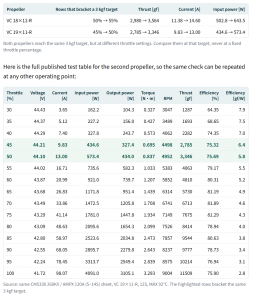
The same sheet also tests a VC 19×11-R propeller. Its 45% and 50% rows give 2,785 gf and 3,346 gf respectively, so the same 3 kgf target lies between those rows. This is why comparing both propellers at 50% throttle would compare different amounts of thrust. Locate the same required thrust in each table before comparing current or input power.
Do not turn this into a rule that the largest propeller always wins. Diameter and pitch change the load, and the result depends on the motor, voltage and operating point. A larger propeller also needs adequate physical clearance and an approved mounting arrangement.
For example, the catalog lists the FLUXER PRO 78×30 in propeller with CW, CCW and paired purchase options. That listing identifies a real product and its selectable rotation directions. It does not establish a tested match to the CM5330 combinations above. Ask for the motor–ESC–voltage combination and its performance report before specifying it.

What usually goes wrong during selection
One buyer compares maximum thrust; another compares the lowest current anywhere in the table. Both can miss the operating point the aircraft will spend most of its flight using. Put the required thrust beside each candidate before comparing numbers.
Temperature deserves the same attention. The website FAQ says the reported MAX temperature in its test parameter table is recorded during a throttle sweep, increasing throttle by 5% every three seconds. That describes a changing-load test. It does not, by itself, establish the temperature after a long hover. Ask for sustained-load data if your mission requires it.
Interpolation can help locate a target between two rows. Keep the estimate modest and verify the result in testing. Do not extend the curve beyond the published range or assume that current remains proportional to thrust.
Buying advice: request the report you can actually use
Keep the chosen table with the sample specification. Record the motor variant, propeller, voltage, ESC and the rows used for hover and higher-load checks. Procurement should be able to identify that combination without asking engineering to reconstruct it later.
For a matched shortlist, send an application request with all-up mass, rotor layout, required thrust, voltage and propeller clearance. Include your candidate table and request the corresponding technical download pack. Files are supplied after the team reviews the platform and SKU family.
Preguntas frecuentes
Can I use a different propeller with the same diameter and pitch?
Treat it as a new candidate until it is checked. Diameter and pitch do not describe every aspect of blade geometry, construction or mounting. The original table belongs to the tested propeller. Ask whether data exists for your substitute, and confirm current, thrust and temperature with the actual motor and ESC before approving the change.
Is a table measured at 50% throttle a reliable hover prediction?
Only if the thrust at that row matches your aircraft’s requirement and the test setup matches your proposed combination. Fifty percent is a command value, not a standard hover condition. Calculate the required thrust first, find the relevant rows and use aircraft testing to confirm the installed result. Do not select from throttle percentage alone.
Why is input power higher than output power?
Electrical input power and mechanical shaft power measure different sides of the motor. Their difference represents losses within the measured system boundary. Input power is calculated from voltage and current; shaft output power can be calculated from torque and rotational speed. Check how the report defines and measures each value before using their ratio as motor efficiency.
Can the maximum-thrust row tell me how much payload I can carry?
It can help assess a candidate, but it is not a payload rating for the complete aircraft. Payload depends on all-up mass, rotor arrangement and the operating margin your platform requires. You also need the current and thermal behavior at sustained and higher-load points. Separate the aircraft’s hover requirement from its maximum tested propulsion output.
What should I ask for if the product page has no thrust table?
Request the report for the exact motor KV, propeller and supply voltage, with throttle, thrust, current and input power columns. Ask how temperature was recorded and whether a sustained-load test is available. The technical download pack is supplied on request; a product name or size listing alone cannot replace the performance data needed for selection.
Should I compare g/W at full throttle or at hover?
Compare it at the operating point you are trying to improve. For a hover-heavy mission, begin at the thrust required to support the aircraft. Then check higher-load operation separately. A good full-throttle figure does not tell you the hover result. Compare reports under equivalent conditions and keep static thrust-per-watt separate from complete-aircraft endurance.