


Drone Battery Selection: Voltage, Capacity and C-Rating
TL;DR
- Drone battery selection comes down to three numbers: pack voltage (series count), capacity in Ah, and C-rating. Set them in that order, because each one constrains the next.
- The examples in this guide come from MAD packs listed in the catalog. Product labels and catalog wording may describe a pack as semi-solid; that wording should not be changed to solid-state without the manufacturer’s technical confirmation.
- C-rating does not add capacity. It only sets how much current a pack can deliver, so an undersized rating shows up as voltage sag, heat and a shorter service life.
Drone battery selection is a three-variable decision, not a single specification. Start with the voltage required by the propulsion system, then compare usable energy, current capability, mass and charging limits for the actual mission. Pack voltage sets the motor KV band and the ESC voltage class. Capacity sets how long the aircraft stays up. C-rating sets how much current the pack can push before it sags. Work through all three against one real platform and you can lock a battery SKU with fewer returns.
Drone battery selection: voltage, capacity and C-rating
Voltage, capacity and C-rating are separate specifications that must be checked together. Changing one may force a different motor, ESC, connector, mass or charging requirement, but the values do not automatically change each other.
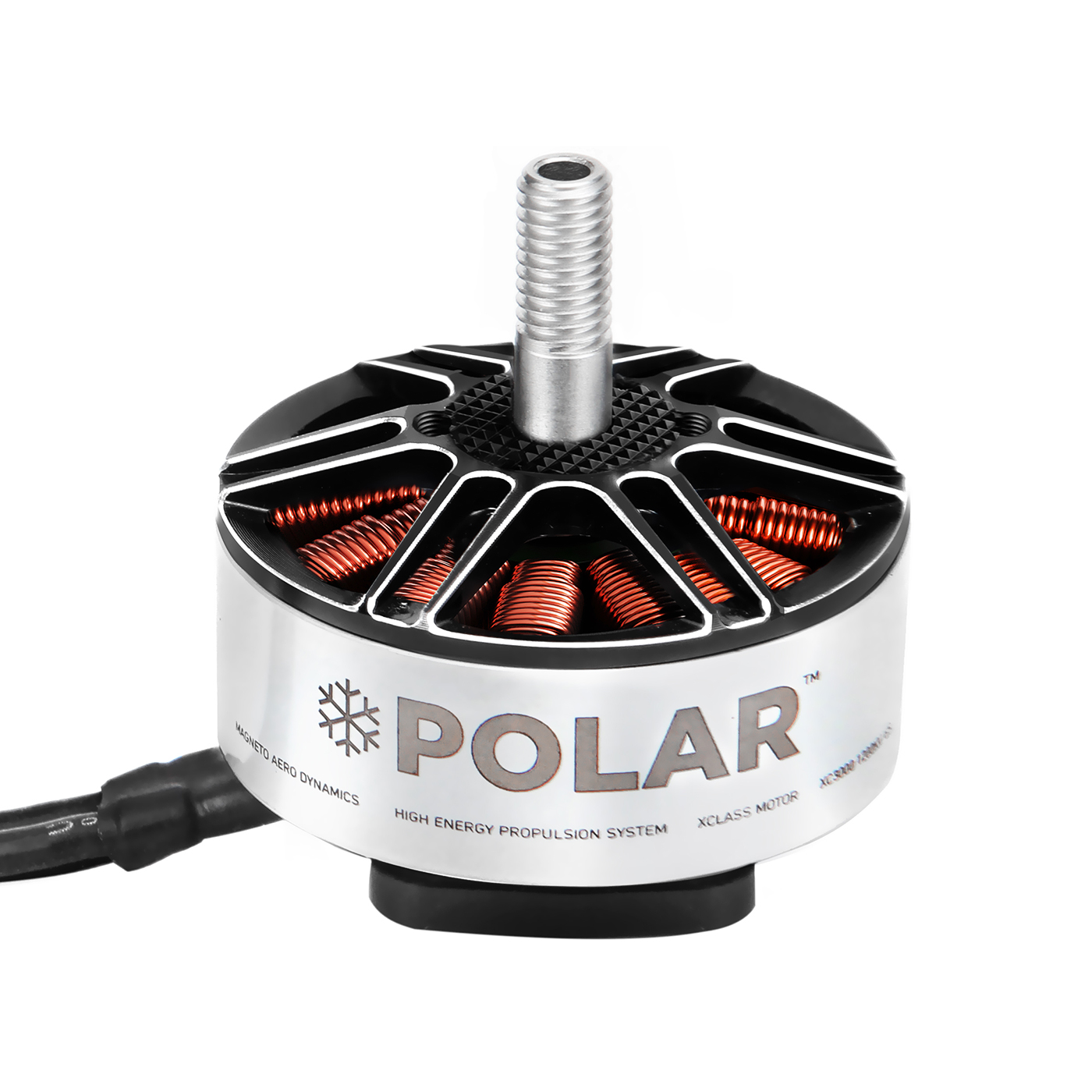
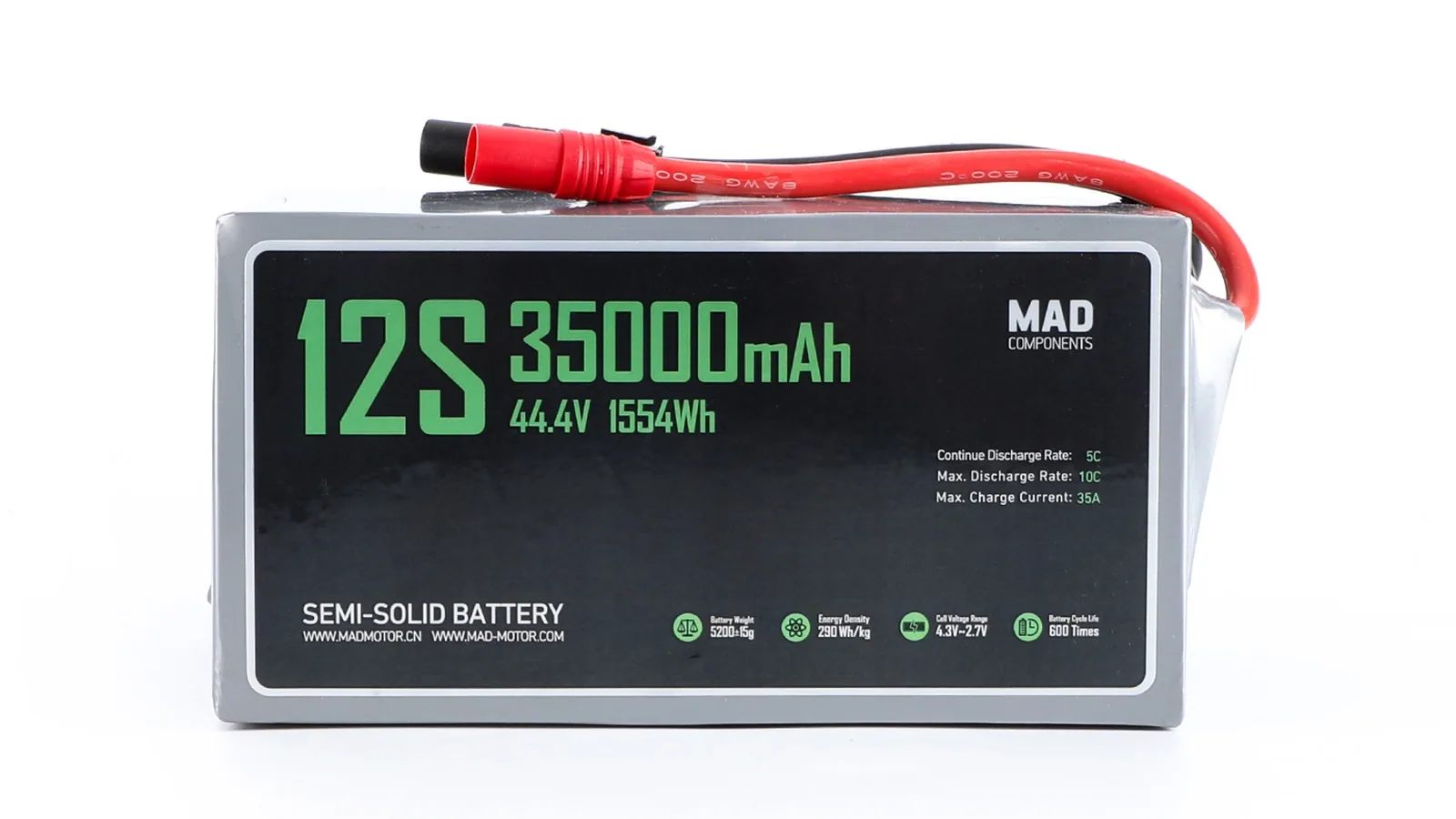
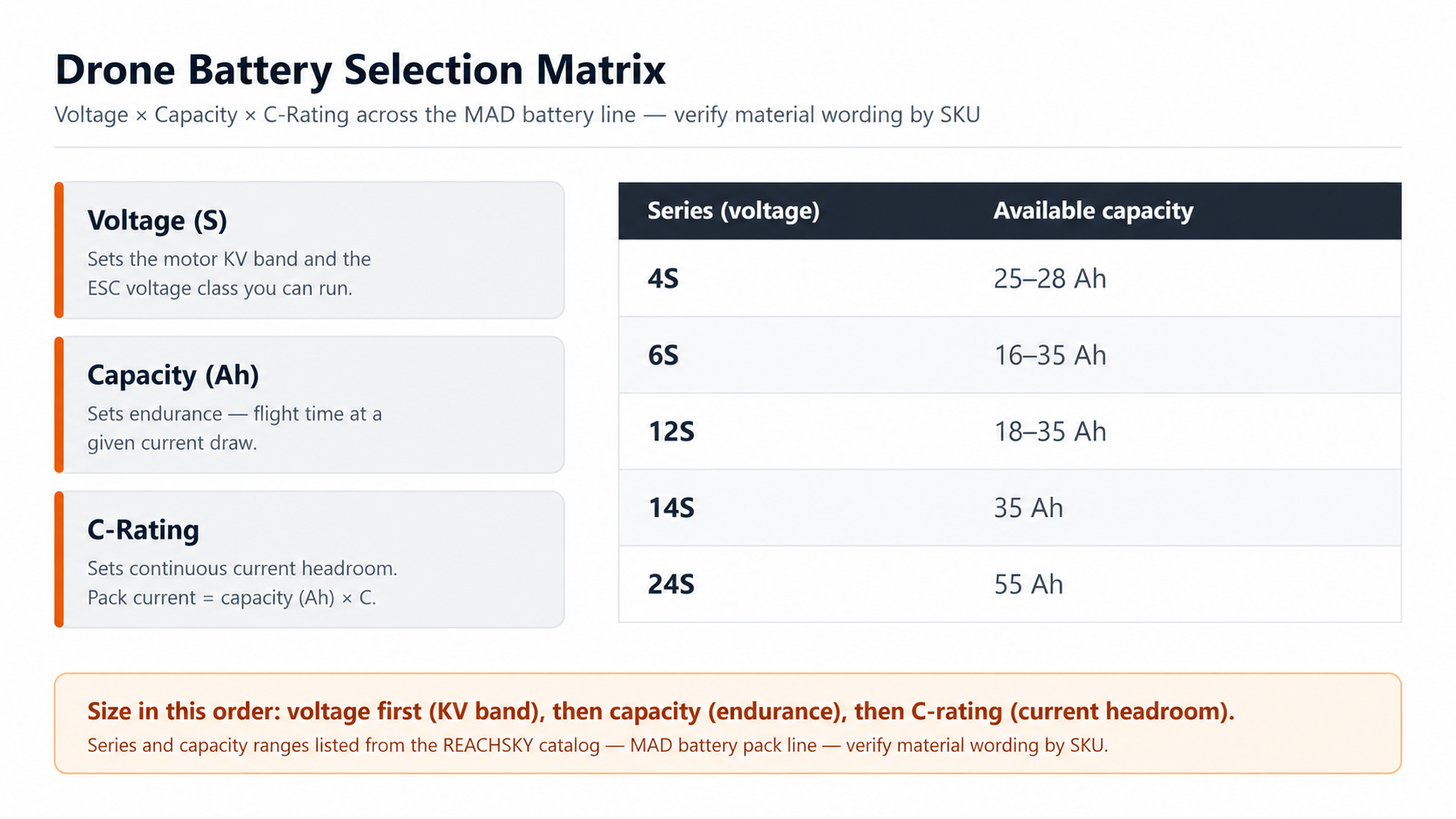
Pack voltage is the series count times cell voltage. The MAD 12S pack carries a 44.4V label and the 24S pack 88.8V, both consistent with roughly 3.7V per cell nominal. Series count fixes two things at once: the KV band your motors should sit in, and the voltage class your ESC, wiring and connectors must tolerate.
- Voltage (S) — sets the motor KV band and the ESC voltage class.
- Capacity (Ah) — sets endurance: flight time at a given average current.
- C-rating — sets the continuous current ceiling and how much the pack heats under load.
Capacity in amp-hours describes charge quantity. When pack voltages differ, compare nominal energy in watt-hours (V × Ah) before using Ah to discuss endurance. Usable energy, aircraft mass, temperature and mission power still determine flight time in practice. At a fixed current draw, a 55 Ah pack runs longer than an 18 Ah pack of the same voltage. C-rating then sets the current ceiling, because pack current equals capacity multiplied by the C-rating. A 55 Ah pack and an 18 Ah pack at the same C-rating can deliver very different continuous currents.
Get the order wrong and the mismatch surfaces later. Too much KV on a high-voltage pack pulls current the wiring was never sized for. A high C-rating on a low-capacity pack still leaves you with a short flight. A big-capacity pack on an airframe that needs agility adds mass you fly with on every mission.
Drone battery selection: what C-rating do you need?
Size the C-rating to your worst-case continuous current, not to a peak burst. Multiply capacity by the C-rating to get the pack’s current ceiling, then keep your mission average clearly below it. A pack that is always run near its limit runs hotter and ages faster, so leave headroom for climbs, wind and payload changes.
Which battery series fits your platform?
Start from the airframe and its duty cycle, then read the series count off the voltage the motors want — capacity and C-rating follow.
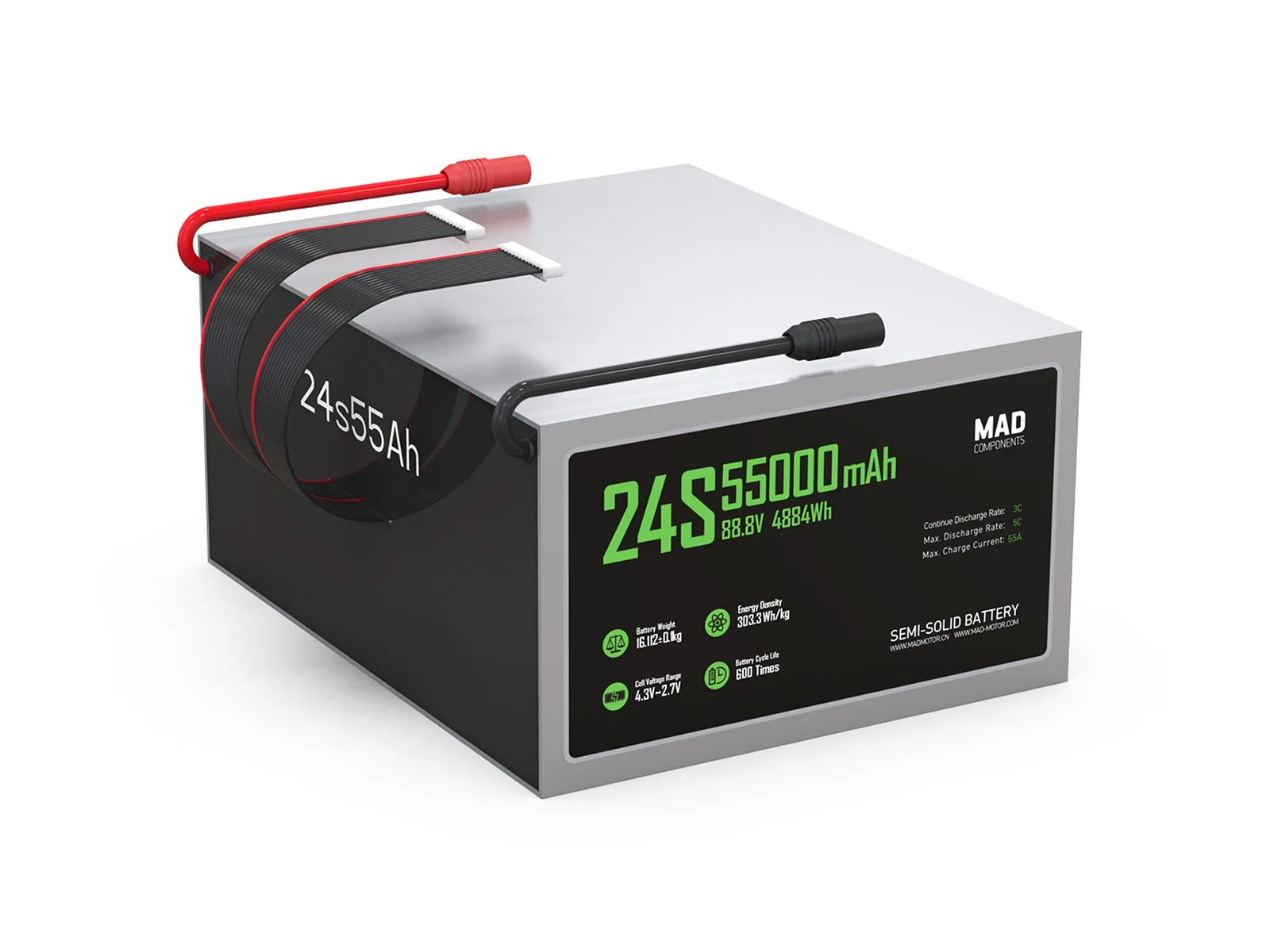
The table below maps platform profiles to the MAD battery series and capacity ranges we stock. Treat the series column as a starting point and confirm it against KV, prop load and continuous current before you commit.
Which battery series fits your platform?
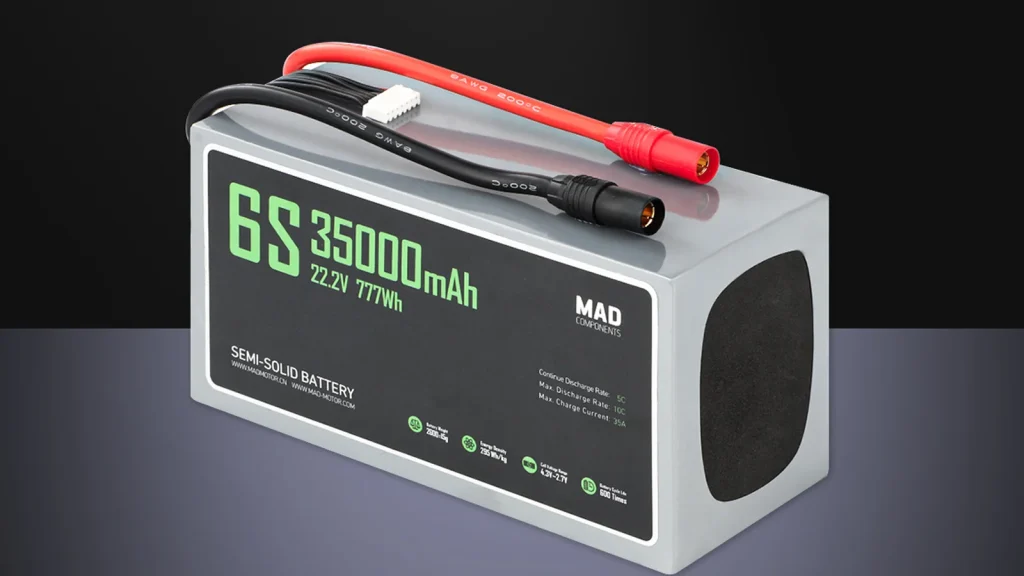
Capacity inside a series is a range for a reason. A 12S airframe can run an 18 Ah pack of cells for short, high-current bursts — see the MAD 12S 35Ah battery as the top of that range — or step up capacity for longer, gentler missions. The pack that fits is the one whose capacity covers your worst-case mission time at your average current, not your best-case hover.
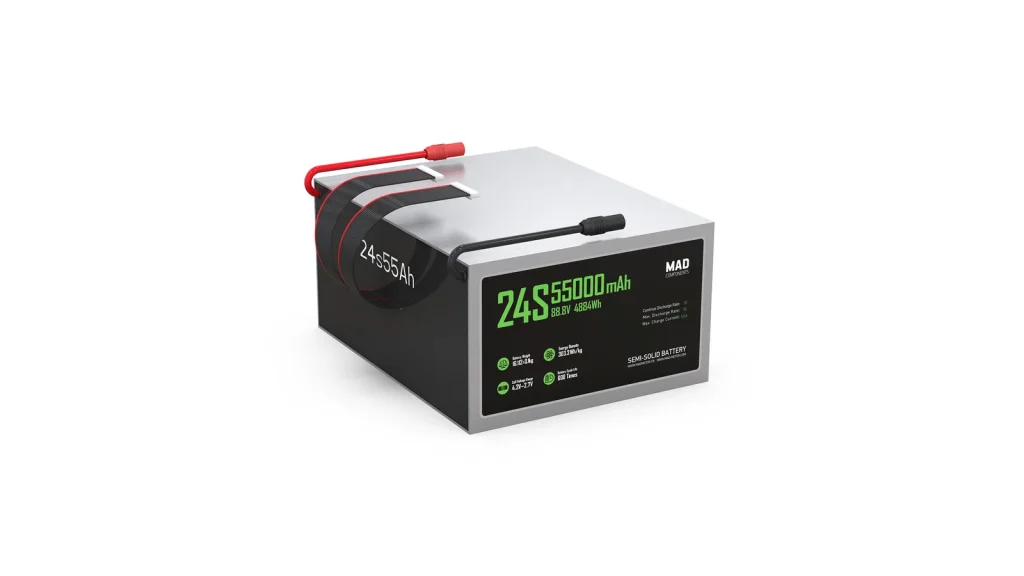
When a platform needs maximum energy on a high-voltage bus, the MAD 24S 55Ah battery is the largest pack in the line. Smaller 4S and 6S packs and every capacity step in between are listed in the drone battery category.
How does battery voltage relate to motor KV?
Pack voltage and motor KV move together: for the same prop load, a higher pack voltage wants a lower KV, and a lower pack voltage wants a higher KV.
KV is a speed constant, not a quality grade. For the same motor, increasing applied voltage raises the approximate no-load speed; it does not change the motor’s KV rating. Loaded speed depends on the propeller, current limit and operating point, so choose the KV band from the complete motor–propeller test data. Push too much KV onto a high-voltage pack and current and heat climb. Run too little KV on a light pack and you leave thrust on the table and invite over-propping.
That is why we size voltage first. Once the pack voltage is fixed, the KV band is a narrow window, and the ESC class and wiring follow from it. We walk through the full mapping in Motor KV and battery voltage; read it before you shortlist motors for a battery change.
Common battery selection mistakes
Most battery problems begin with a mismatch between the pack and the aircraft duty cycle. Use the following checks before requesting a quotation.
- Buying on capacity alone. Capacity sets flight time but says nothing about voltage fit or current headroom.
- Treating C-rating as a performance upgrade. A higher C-rating does not add energy; it only raises the current ceiling.
- Mixing series counts in one fleet. A 6S airframe and a 12S airframe need different motors and ESCs, so spares do not cross over.
- Forgetting charge current. A big pack needs a charger and balance path that can actually fill it inside your turnaround.
- Ignoring pack mass. More capacity means more weight, and that weight is carried on every flight.
- Assuming a bigger pack always flies longer. If the added mass raises hover current by more than the extra energy supplies, endurance can fall.
Buying MAD catalog battery packs: MOQ, lead time and compliance
Because battery projects carry MOQ, terms and lead-time questions, treat the purchase as a B2B enquiry rather than a one-click order.
We quote from configuration and volume, so the catalog shows list bands rather than fixed project pricing. What you can plan around:
- Samples: availability, MOQ, lead time and shipping documents are confirmed per SKU and destination; do not assume one catalog rule applies to every battery.
- MOQ: no hard batch floor; the batch MOQ depends on the SKU, the marking method and the packaging you need, and is confirmed per project.
- Trade terms: EXW, FOB, CIF or DDP, chosen by destination, transport mode and importer requirements.
- Lead time: in-stock replenishment in 3–10 business days, standard samples in 7–15 business days, and OEM or private-label runs in 25–40 business days measured from sample approval, artwork sign-off and deposit.
- Warranty: 12 months on standard products unless the quote or datasheet states otherwise.
- Certification: an ISO 9001 quality system with RoHS and REACH aligned processes; documents are provided on request. The ISO 9001 standard and the EU REACH regulation are the reference points for those processes.
- Documentation: ask for the SKU-specific datasheet, SDS and applicable transport documents; the required set depends on the destination and carrier.
If a volume project needs custom marking, wire length or matched propulsion, send the platform brief and we will confirm the configuration before pricing. Use request a quote for that path, or pull the datasheets and CAD packs first if your engineers want the files in hand.
Frequently Asked Questions
How do I choose between a 6S and a 12S drone battery?
Choose by the KV band your motors need, not by habit. A 6S pack pairs with higher-KV motors and smaller airframes; a 12S pack halves the current for the same power, which suits larger industrial and cargo platforms. Fix voltage first, then pick capacity and C-rating.
What C-rating does a drone battery actually need?
Match the C-rating to your worst-case continuous current, not to peak bursts. Multiply capacity by the C-rating to get the pack’s current ceiling, then keep your mission average well below it. A pack that is always run near its limit runs hotter and ages faster, so leave headroom.
Does a higher cell count always mean longer flight time?
No. Cell count sets voltage, not energy. Flight time depends on capacity and total current draw, so a high-voltage pack with modest capacity can fly shorter than a lower-voltage pack with more amp-hours. Size voltage for the motor band and capacity for endurance, and treat them as separate decisions.
What capacity range fits an agricultural spraying drone?
The catalog examples include 6S and 12S packs used in agricultural applications. Confirm the current SKU, dimensions, weight, connector, charge limit and duty cycle before treating a range as suitable for a specific aircraft. Pick the smallest capacity that covers your tank-to-tank mission time at average current; extra capacity adds weight you carry on every flight. Confirm the choice against your duty cycle.
Can I mix different series counts in one drone fleet?
You can, but keep the KV bands and ESC voltage classes separate. A 6S airframe and a 12S airframe need different motors and ESCs, so spares do not cross over. Standardise where maintenance cost matters, and keep mixed fleets only where the missions are genuinely different.
What is the MOQ for MAD catalog battery packs?
Samples start at one piece through the catalog; there is no hard batch floor. Volume MOQ depends on the SKU, the marking method and the packaging you need, so it is confirmed per project. The MAD 12S 35Ah battery quotes volume pricing from 50 pcs.
Which certifications come with your drone batteries?
REACHSKY works to an ISO 9001 quality system with RoHS and REACH aligned processes, and documents are provided on request. Certification scope depends on the SKU and the destination market, so confirm requirements in the quote. We only state certifications the specific part actually holds.
Conclusion
For the next step, read our battery charger selection guide and check the pack chemistry, supported cell count, charge-current limit and connector arrangement before choosing a charger.
Voltage, capacity and C-rating are one decision made in three steps. Pick the series count that matches your motor KV band, set capacity to cover your worst-case mission time, then leave C-rating headroom above your continuous current. Done in that order, battery selection stops being a guessing game and becomes a specification.
If you are sizing packs for a distributor range, a fleet or an OEM program, send us the airframe weight, duty cycle and target ship window. Our engineers reply with a matched configuration rather than a generic catalog answer: request a quote.
All products are supplied for civil end use only.
By REACHSKY Engineering Team REACHSKY supplies UAV propulsion components from Changsha, China, with an in-house R&D team and factory for self-developed parts (ISO 9001) and authorized distribution across North America, South America and Europe.
Last updated: 2026-10-11
Related articles
-
 Solid-State Li-Ion vs LiPo for Long-Endurance UAVs
Solid-state Li-ion packs trade peak current for energy density and cycle life. Match chemistry to mission profile before you fix a pack SKU.
-
 How to Extend Drone Battery Cycle Life
Storage voltage, charge rate, temperature and depth of discharge decide drone battery cycle life. Here is the routine that keeps a fleet inside the curve.
-
 Battery Charger Selection: 1–14S vs 12–24S
Battery charger selection at a glance The 1–14S charger class spans the widest cell range and the widest channel spread, from single-channel units up to the four-channel SKYRC…