


How to Choose Motor KV and Battery Cell Count for a Heavy-Lift Build
How to Choose Motor KV and Battery Cell Count for a Heavy-Lift Build
Choosing a heavy-lift motor starts with the battery voltage and propeller envelope, not with a KV number in isolation. KV describes unloaded speed per volt; the pack, propeller, motor size and ESC limits determine how that motor behaves in the aircraft.
What KV tells you
A higher KV motor tends to spin faster per volt without load. It does not by itself establish thrust, efficiency or safe battery voltage. Record KV, pack voltage, propeller diameter and pitch, take-off mass and ESC current together.
Match cell count to the system
Cell count sets nominal pack voltage. A higher series count can reduce current for the same power target, but changes motor speed and the voltage class of the ESC, connectors and charger. Confirm the exact SKU and datasheet before ordering.
Heavy-lift selection sequence
- Define take-off mass, payload and thrust margin.
- Set propeller diameter from frame clearance.
- Shortlist voltage and KV together.
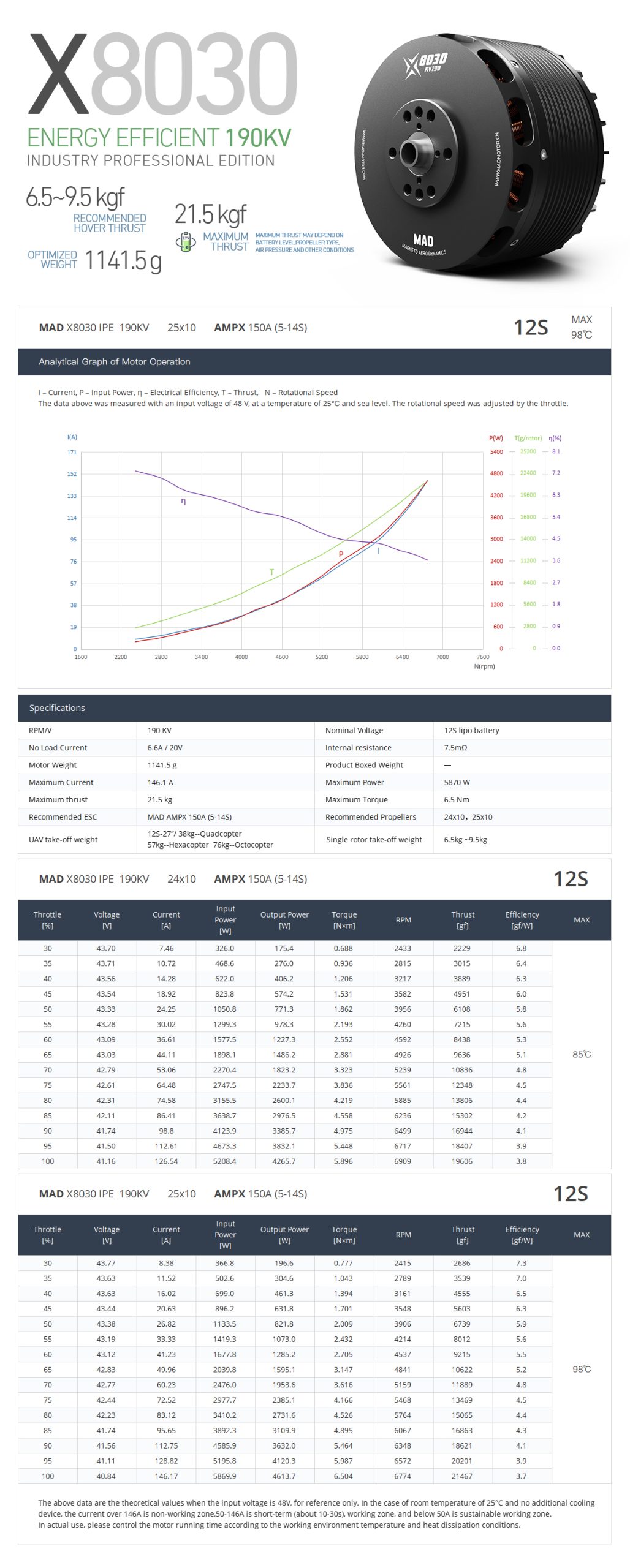
- Read the thrust table at target voltage and throttle.
- Size ESCs, connectors and batteries around measured current.
Start with the aircraft, not the motor label
Heavy-lift procurement usually starts with a payload requirement, but the payload number is only one part of the calculation. Record the empty aircraft mass, battery mass, payload, reserve margin and expected operating altitude. A motor that looks suitable on a bench may have little margin once the battery and payload are installed.
For a fleet or OEM program, keep the same assumptions in the RFQ and in the validation report. Changing the propeller or pack voltage after the quote can move the operating point outside the original thrust-table data.
Use thrust tables at the intended operating point
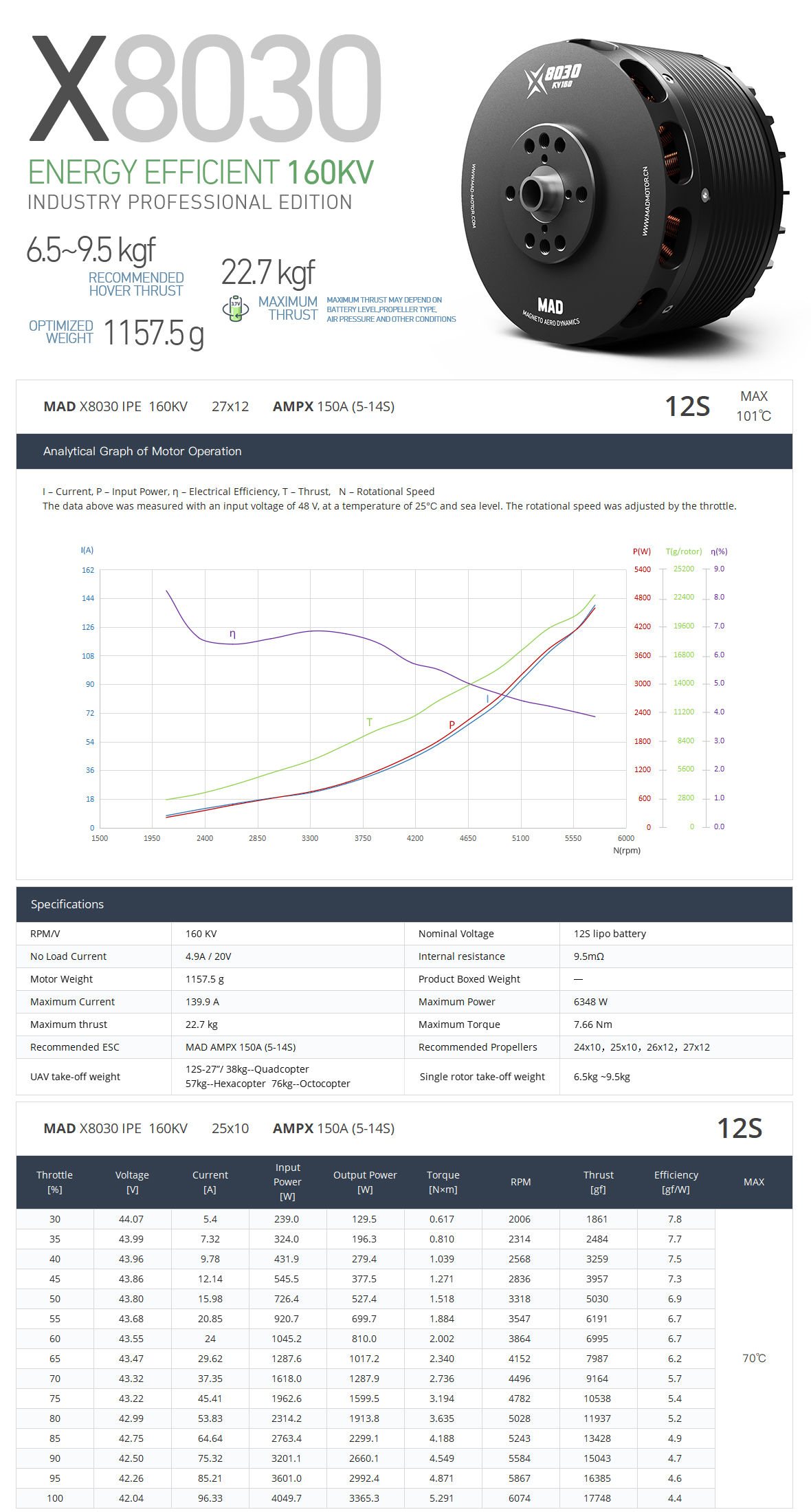
A thrust table is useful only when the test voltage, propeller and throttle range are close to the planned aircraft configuration. Compare the thrust column with current and efficiency, then check whether the required hover thrust sits in a reasonable throttle band. Avoid selecting a motor from its maximum headline thrust alone.
When two candidates appear similar, compare heat, current and noise at the same thrust target. The lower-current option may offer more usable endurance, while a larger motor may provide more thermal margin. These are engineering trade-offs rather than universal rules.
KV, propeller diameter and voltage move together
Increasing voltage changes the motor speed range. Increasing propeller diameter or pitch increases aerodynamic load. These changes interact, so a KV value cannot be transferred from one pack and propeller combination to another without checking the data again.
- Higher voltage can shift the suitable KV band downward for a similar propeller target.
- A larger propeller can increase thrust and current demand at the same voltage.
- ESC, connector and battery limits must be checked at the same operating point.
What to confirm before a sample order
Ask for the exact motor drawing, shaft and mounting details, recommended voltage range, compatible propeller information and test conditions. Confirm whether the quoted product is an EEE or IPE version, whether the label represents a finished SKU, and which accessories are included. If a parameter is not shown in the product documentation, leave it as a supplier-confirmed item rather than filling the gap with a generic assumption.
Thermal margin matters more than a headline number
Heavy-lift aircraft spend long periods near hover, so the motor and ESC may operate at a sustained load rather than a short burst. Review winding temperature, bearing condition, airflow and the mounting path that transfers heat into the arm. A specification that is safe on a cool bench may need a lower operating point inside a covered airframe.
When comparing suppliers, request the test voltage, propeller, ambient condition and measurement duration. Keep those details with the sample record so a second batch can be checked against the same assumptions.
Battery selection is a system decision
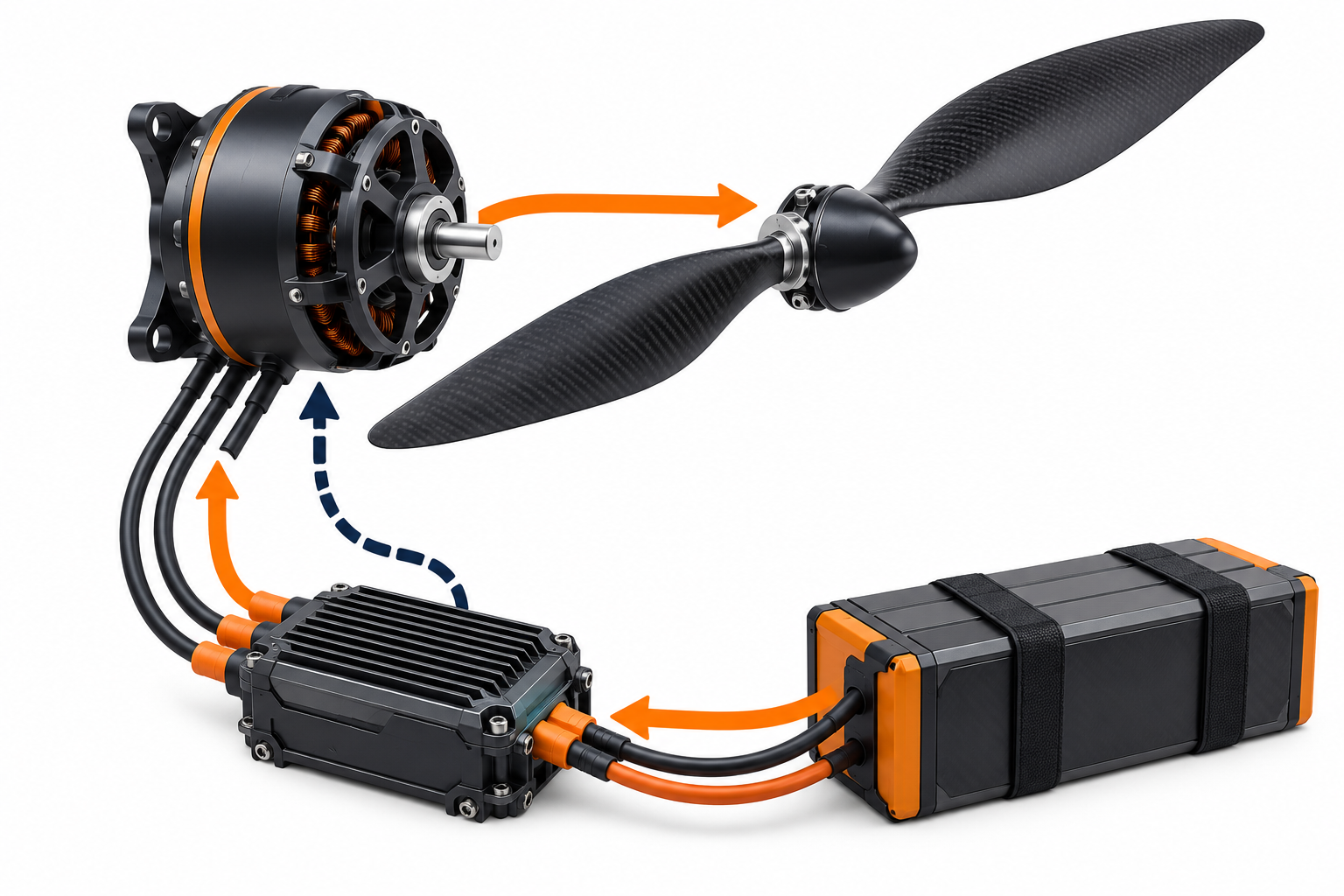
Cell count is only one battery input. Capacity affects mass and endurance, discharge capability affects current headroom, and the connector and cable affect losses and serviceability. A larger pack can add enough mass to change the thrust requirement, so battery selection should be repeated after the motor and propeller shortlist is known.
Documentation to keep for repeat orders
For a repeat order, preserve the approved motor drawing, propeller reference, pack voltage, connector, cable length, label artwork and inspection notes. If the supplier changes a bearing, winding, connector or firmware-related component, ask for the change to be identified before shipment. This is especially important when a fleet uses matched propulsion sets across multiple airframes.
Build a repeatable approval sheet
Before approving a heavy-lift combination, record the motor SKU, KV, voltage, propeller model, battery configuration, ESC model, connector and test date on one sheet. Add the measured thrust, current and temperature at the selected operating point. This gives purchasing, engineering and after-sales teams one reference when a repeat batch is requested.
Keep uncertain items visible. If a mounting hole pattern, bearing option or battery connector still requires supplier confirmation, mark it as pending rather than turning a provisional value into a general specification.
Example of a procurement review
Suppose a platform team has a known payload, a fixed frame clearance and a preferred battery family. The review should first set the target thrust per motor, then compare the motor and propeller at the intended voltage. If the selected point requires unusually high throttle or pushes the ESC close to its continuous limit, the team should revisit the combination before placing a volume order.
This sequence keeps the discussion practical: the supplier can see the operating point, the buyer can compare like with like, and the final SKU can be recorded for repeat purchasing. It also prevents a motor name or KV number from being treated as a complete propulsion specification.
Questions for a supplier before approval
- Which voltage and propeller were used in the quoted thrust data?
- Are the current figures continuous, peak, phase or battery current?
- What mounting, shaft, bearing and connector details belong to this SKU?
- Are the motor and propeller supplied as a matched recommendation or selected separately?
- Which data should be repeated during incoming inspection?
For a commercial program, keep the approved specification with the purchase order and sample record. If the application, pack voltage or propeller changes, treat it as a new review rather than assuming the previous selection still applies. Buyers can also request a technical discussion through the Reachsky OEM inquiry route.
KV is a speed constant, not a thrust rating
Motor KV is commonly used as an unloaded speed constant in revolutions per minute per volt. It is useful for comparing the speed range of a motor, but it does not predict the thrust of a complete propulsion unit. Thrust depends on the motor’s torque capability, the propeller’s diameter and pitch, the applied voltage, current, air density, and the operating point shown in a valid test table.
For heavy-lift work, avoid the shortcut “lower KV means more thrust.” A lower KV motor may be suitable for a larger propeller at a higher voltage, but the final result still depends on the motor, propeller, ESC and battery working together.
Use all-up weight and thrust margin first
Start with the aircraft’s all-up weight: frame, arms, motors, ESCs, battery, wiring, landing gear and payload. Divide the required total thrust across the installed motors, then add the margin required by the platform and mission. The exact margin is a design decision; it should not be copied from a generic internet rule.
Once the per-motor target is known, read the candidate motor’s thrust table at the intended voltage, propeller and throttle. A maximum thrust headline is less useful than a measured point that matches the aircraft’s normal hover and climb conditions.
How battery cell count changes the operating point
Cell count sets nominal pack voltage. For a similar power target, a higher voltage can reduce current in the battery and wiring, but it also changes motor speed, ESC voltage class, connector selection and charger requirements. Do not move from one cell count to another without rechecking the propeller, motor current and ESC limits.

Read a thrust table as a system document
Check the test voltage, propeller model, throttle points, thrust units, current, input power and efficiency. If the table does not identify the propeller or test conditions, treat it as incomplete for procurement. Compare candidates at the same thrust target rather than comparing maximum values from different setups.
What a heavy-lift RFQ should contain
- All-up mass and payload range;
- Number of motors and frame clearance;
- Target battery cell count and capacity range;
- Propeller diameter, pitch and rotation requirements;
- Expected quantity, destination market and sample needs;
- Required documents and the information that must appear on the label.
Technical sources and limits
Public motor-selection guides consistently warn that KV must be read with voltage and propeller data. Reachsky should still rely on the selected SKU’s own test table for a quotation. The Fioparts heavy-lift motor guide 以及 Pi Thrust KV explanation are useful background references, not substitutes for a manufacturer data sheet.
常见问题解答
Does higher KV always mean more thrust?
No. Thrust depends on motor torque, propeller load, voltage, efficiency and operating point.
Can the same motor be used on 12S and 24S?
Only when the exact motor, propeller, ESC and operating limits support the intended voltage.
What should an RFQ include?
Send mass, payload, flight-time target, voltage, propeller envelope, quantity and application.
Where can I compare motors?
Motor category · MAD 1005 EEE BLDC motor · KV and battery voltage guide.
相关文章
-
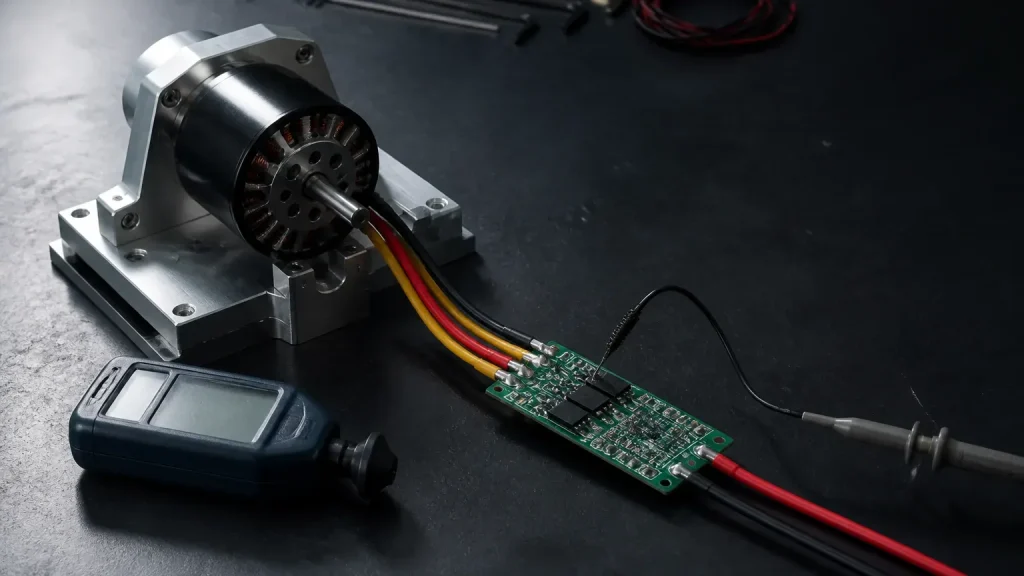 Motor Desync High Current: Causes and Fixes
Why a motor loses commutation exactly when current climbs, the six causes in the order worth checking, and a bench routine that makes desync repeatable.
-
 FPV Motor Series Explained: BSC, CM, FS and KONKER
A series name helps you find a motor. It does not finish the selection. ??inematic??is not a payload rating, ??reestyle??is not a battery specification, and ??asic??does not tell…
-
 Drone Motor Bearing Maintenance and Replacement Intervals
A motor that sounds different after a prop strike needs an inspection, even if it is far from its planned service date. A motor that sounds unchanged still…
-
 Heavy-Lift Drone Motor Selection: Payload, Thrust and Redundancy
A step-by-step heavy-lift drone motor selection method: payload to all-up weight, thrust per arm, redundancy reserve, then a datasheet check on the AM110.