


Heavy-Lift Drone Motor Selection: Payload, Thrust and Redundancy
A step-by-step heavy-lift drone motor selection method: payload to all-up weight, thrust per arm, redundancy reserve, then a datasheet check on the AM110.
TL;DR
- Required thrust per arm is all-up weight multiplied by the thrust-to-weight target and divided by motor count. A 240 kg hexacopter at 1.8:1 needs 72 kgf at each arm.
- Redundancy is a formula, not a feeling. With n motors, installed thrust-to-weight has to reach roughly 1.15 × n ÷ (n − 1) before the aircraft can hold altitude after one motor stops.
- The datasheet decides the last step. The AM110 is rated 96 kgf with a 193 kgf peak, weighs 10.4 kg and runs 24S at 350–400 V; the peak number is a transient figure, not a hover target.
A heavy-lift drone motor selection starts with the weight the aircraft has to hold, not with the biggest thrust number in a catalog. This guide turns a payload requirement into a per-arm thrust figure, applies a redundancy rule matched to motor count, then checks the answer against a real datasheet. You finish with one candidate and one number to validate on the bench.
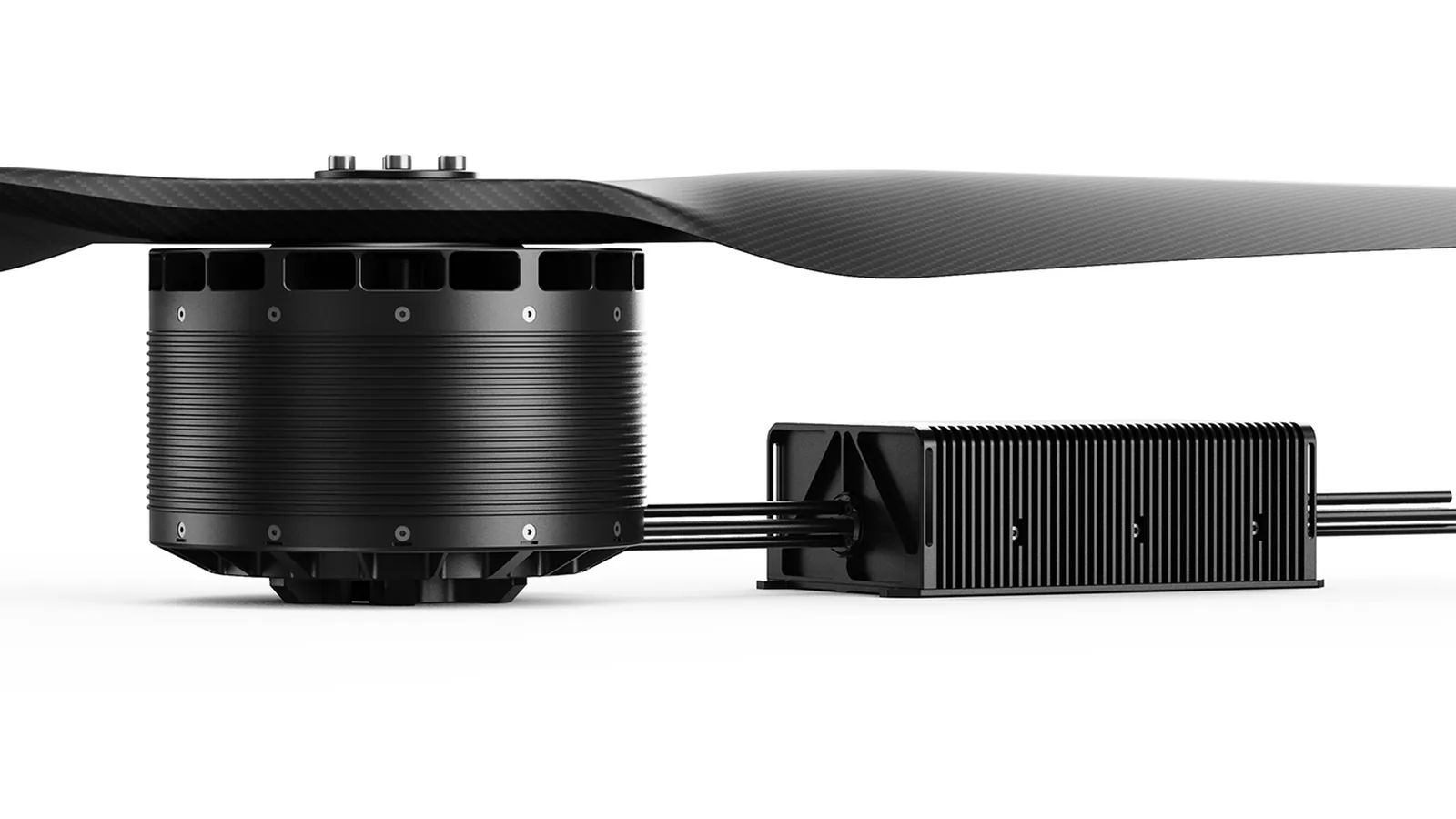
The propulsion unit, not the motor alone, is what the payload calculation has to cover: motor, propeller, ESC and the wiring between them.
Heavy-Lift Motor Selection: Comparison Guide
Start with all-up weight, not with a motor label
All-up weight sets the motor size; the motor label does not set the payload. Build the mass budget first, because every later component changes the thrust the motors must produce.
The budget must include items that are easy to forget:
- Airframe, arms, landing gear and payload mount
- Motors, multiplied by count (an AM110 is 10.4 kg each, so a hexacopter carries 62.4 kg of motor alone)
- ESCs, power distribution, wiring harness and connectors
- Propellers, including the hub and adapter hardware
- Battery pack at the capacity you actually need, not the smallest pack that fits
- Payload, plus any gimbal, spray tank or cargo fixture
That list hides a loop. Six AM110 motors add 62.4 kg, 26% of a 240 kg aircraft, so size the motors, add their mass, then check the ratio again. A budget run once is a budget that lies.
How much thrust does each arm actually need?
Thrust per arm is total weight times the thrust-to-weight target, divided by motor count. Nothing else in the calculation is negotiable; the ratio is a design decision you have to defend.
Thrust per arm (kgf) = all-up weight (kg) × thrust-to-weight target ÷ motor count
Worked example for a 240 kg hexacopter with a 1.8:1 target:
240 × 1.8 = 432 kgf total, and 432 ÷ 6 = 72 kgf per arm.
72 kgf against the AM110’s 96 kgf rating leaves 25% headroom at the design point. That headroom is what absorbs a hot day, a dirty propeller, a slightly heavier battery, and the fact that a multirotor never shares thrust perfectly between arms.
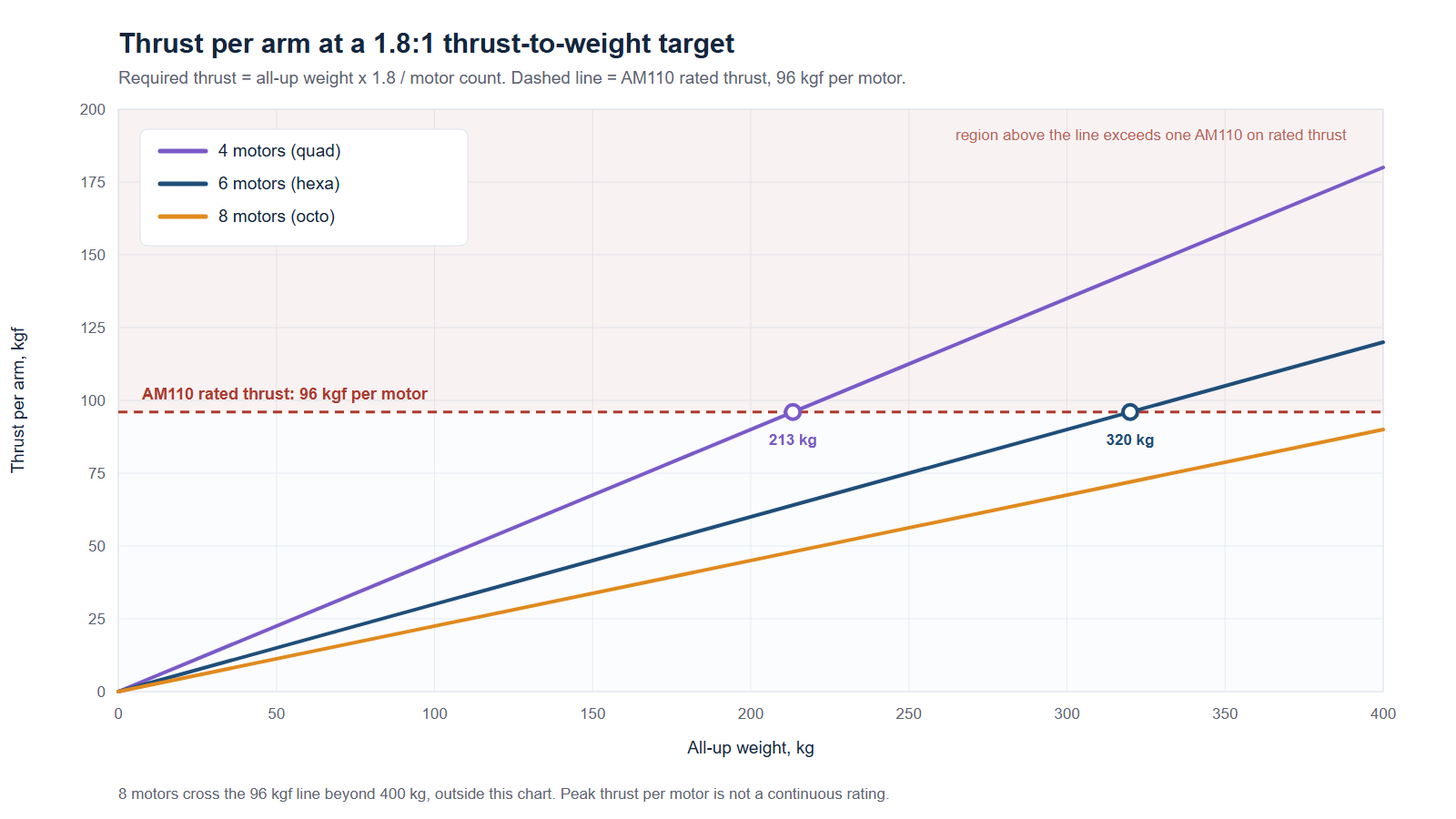
Our own plot of the per-arm calculation at a 1.8:1 target. With AM110 motors, a hexacopter reaches the 96 kgf rating at 320 kg and an octocopter only beyond 400 kg.
Read backwards, the same arithmetic says when a motor is too small. Above roughly 75% of rated thrust per arm, the aircraft lives in the top quarter of the envelope, where winding temperature and bearing life, not thrust, limit the mission.
What thrust-to-weight ratio should a heavy-lift drone use?
For civil heavy-lift multirotors we size to 1.7–2.0 installed thrust-to-weight at maximum take-off mass. Below 1.6, gust response and climb rate get thin; above 2.2, you are carrying motor and propeller mass that could have been battery or payload.
The ratio does two jobs at once, and it is worth separating them:
- Control authority. A multirotor steers by differential thrust. At a 1.5:1 ratio the aircraft hovers near 67% of available thrust, and there is little left for a gust or a yaw correction without saturating an arm.
- Thermal life. Hover dominates delivery and survey work. Sizing so hover sits at 45–55% of the per-arm rating keeps continuous current, and stator temperature, inside a range the motor holds for a full mission.
Air density moves both numbers. Thrust scales approximately with density, so the same motor and propeller lift less as elevation rises:
A 240 kg aircraft rated at sea level needs more motor or a longer propeller at 2,000 m. These ratios follow the International Standard Atmosphere; confirm the figure with a test at your site.
Redundancy: what is left after one motor stops?
Redundancy is a thrust budget that can be written down before you choose a motor. To hold altitude on n − 1 motors with a 15% control reserve, installed thrust-to-weight must reach about 1.15 × n ÷ (n − 1).
That gives three working figures: 1.53 for a quadcopter, 1.38 for a hexacopter, and 1.31 for an octocopter. The 15% reserve is a design choice, not a regulatory number; it covers the thrust the flight controller needs for attitude correction while the aircraft is already degraded.
Two rules follow from the table:
- Choose motor count for redundancy before you choose motor size. A hexacopter at 1.8:1 survives a motor failure; a quadcopter at 2.2:1 does not.
- Do not count peak thrust in the redundancy case. The 193 kgf peak depends on the ESC, pack and airflow; redundancy works on the rating the motor holds.
Where KV and cell count fit, and what this guide does not cover
KV and cell count sit inside this decision: they set which voltage class and speed constant make the required thrust achievable with your propeller. We covered that step in Motor KV and Battery Cell Count for Heavy-Lift Builds.
The split is deliberate. That article answers which KV at which pack voltage; this one answers how much thrust each arm needs and what is left if one arm stops. Fix the per-arm thrust and the motor count here, then pick the voltage and KV band there. A KV number chosen before the per-arm thrust produces a shortlist that reads well and flies badly.
Confirm the shortlist against the datasheet, not the brochure
A heavy-lift drone motor selection is confirmed when the published limits sit outside your demand with room for altitude, heat and propeller tolerance.
For the AM110, the published figures are:
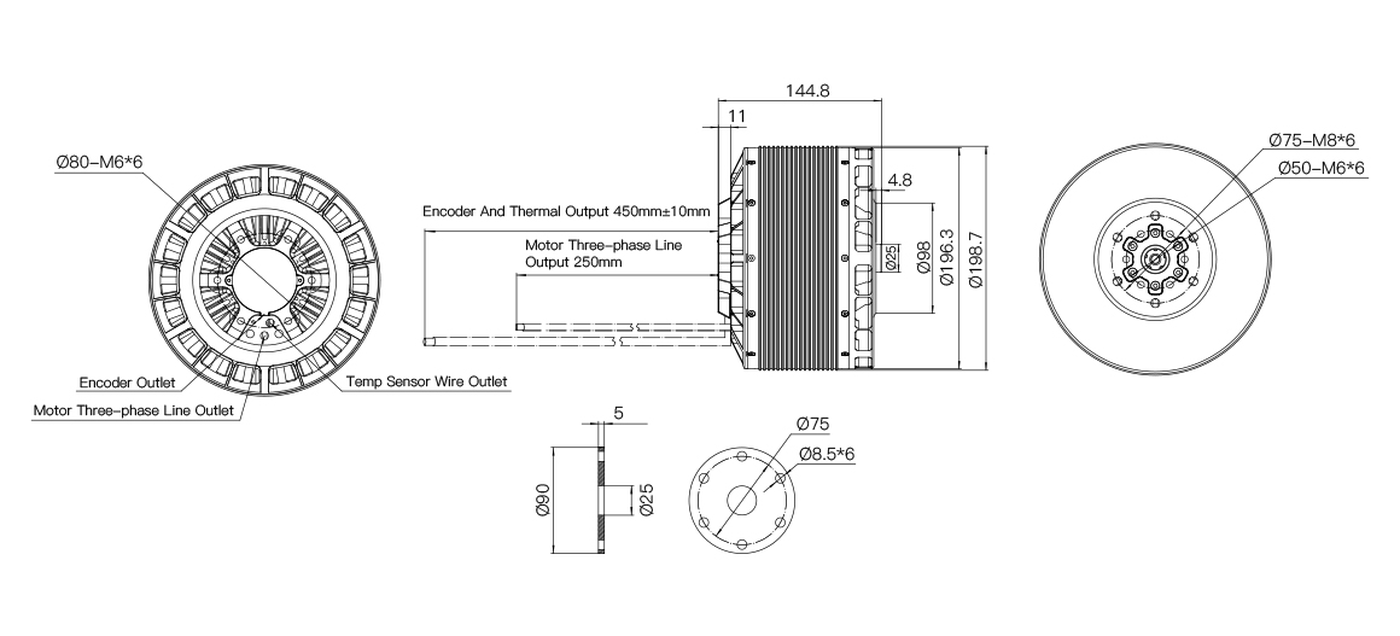
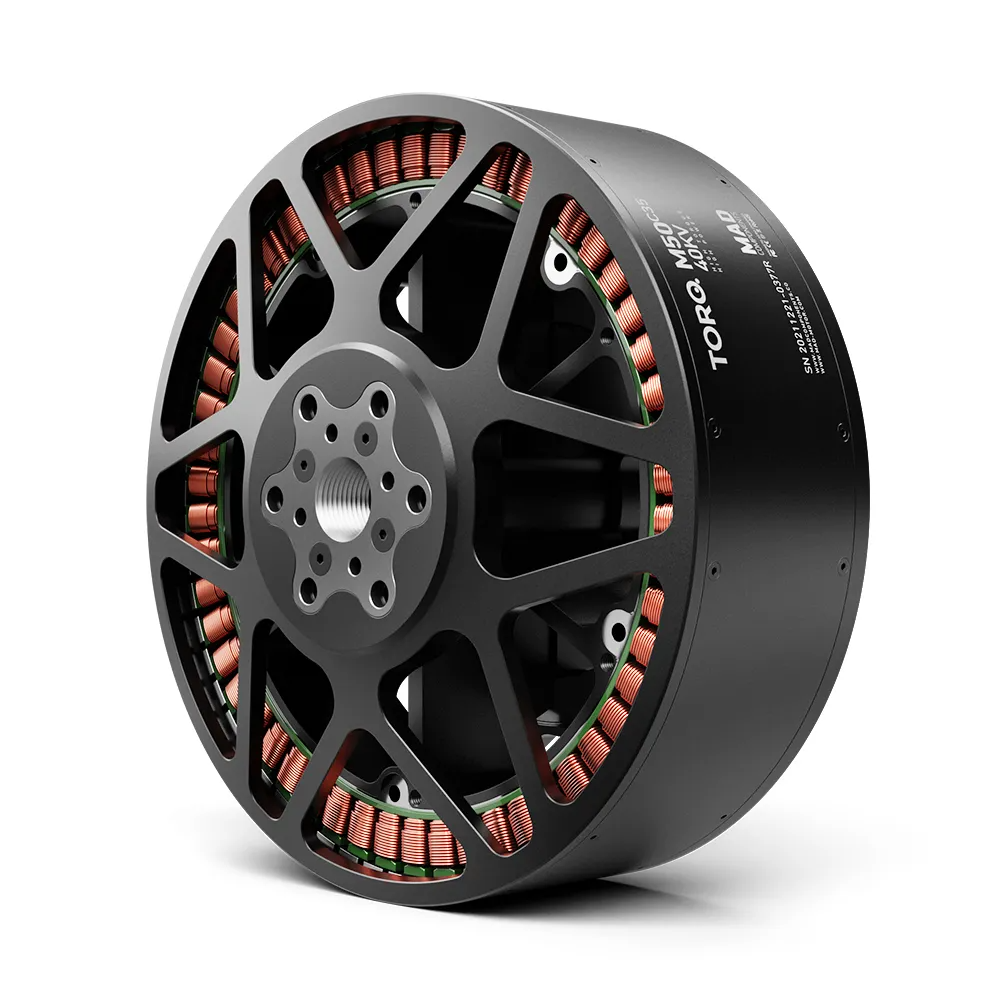
The supplier drawing for the AM110 gives the numbers a brochure leaves out: 144.8 mm overall height, three different bolt circles, and the 250 mm / 450 mm lead lengths that decide your arm routing.
Mounting is where a shortlist usually dies. A motor that meets the thrust target but uses a 50 mm bolt circle will not bolt to an arm plate drilled for 80 mm, and re-machining after qualification means a new vibration survey.
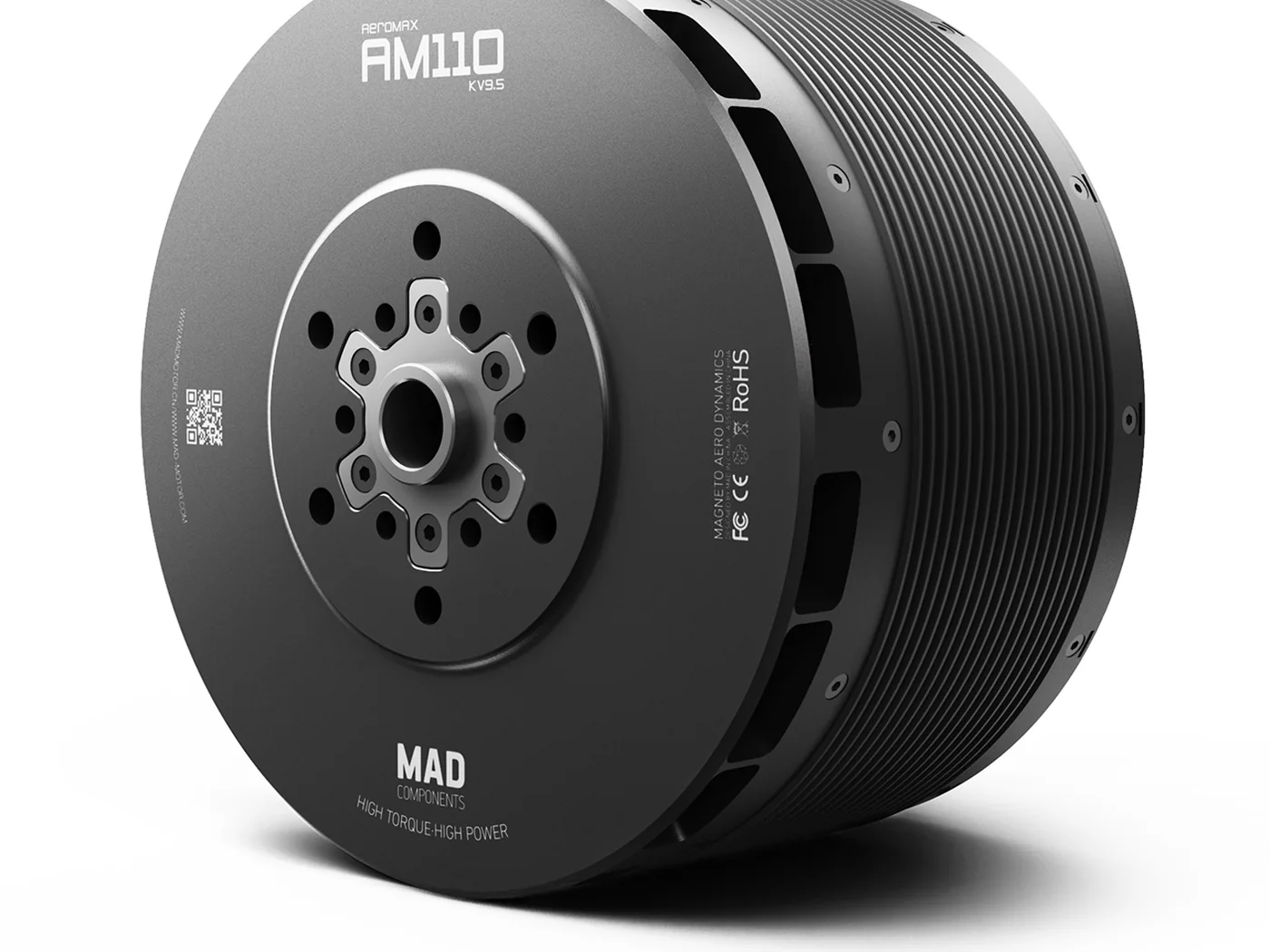
The finned housing and the vented bell are the parts of the thermal path you can see; the winding temperature they protect is the number that limits continuous thrust.
For what sits behind those vents — segmented magnets, shaft and bearing stack — see 重型无人机电机内部结构:磁铁、通风口和轴.
Size the ESC and the propeller around the motor you chose
The motor is confirmed only when the ESC and propeller are confirmed with it. Three checks close the loop:
- ESC continuous current. Read motor current at the design thrust point, not at peak, and leave headroom for voltage sag. An ESC rated at exactly the measured current runs hot.
- Propeller diameter. Frame clearance sets the maximum; the motor and KV set what that diameter can absorb. A longer propeller at the same KV raises current faster than thrust.
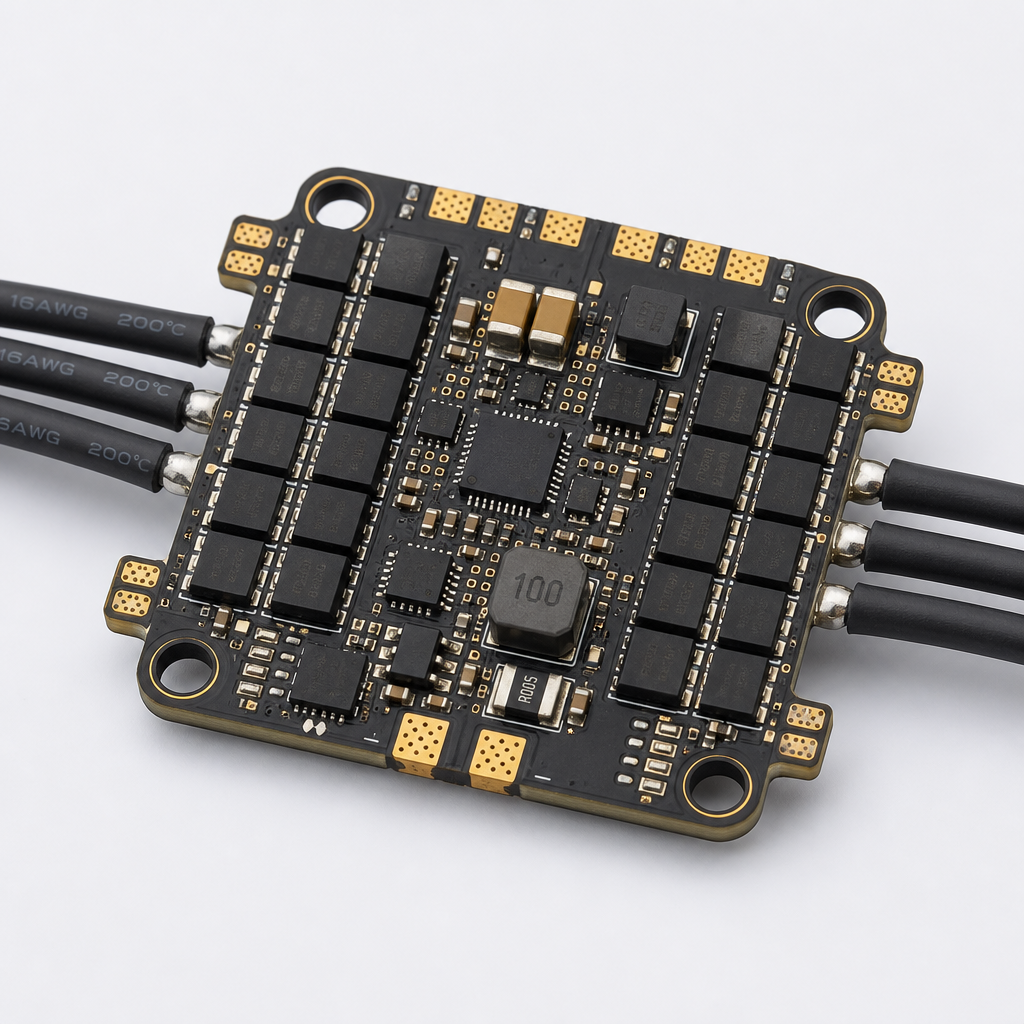
- Wiring and connectors. At 24S the connector, cable gauge and pre-charge method are part of the design. The AM110 product page shows the motor next to a SineSic 160A ESC, but a photograph is not a bill of materials: confirm the ESC SKU in the quotation.
What to verify before you place a heavy-lift motor order
Procurement questions are engineering questions with a date attached. Ask them while the design is still flexible.
- Sample quantity. One piece is enough for a bench test; order it before the volume discussion.
- MOQ. No fixed threshold; it depends on the SKU, labelling method and packaging. Ask against your actual configuration.
- Lead time. Stock replenishment runs 3–10 business days, standard samples 7–15, and OEM or private-label batches 25–40 from sample approval and deposit.
- Terms and warranty. EXW, FOB, CIF and DDP are all available; the choice follows destination, mode and import risk. Warranty runs 12 months on standard products unless the quotation says otherwise, claims tracked by PO and batch.
- Documentation. ISO 9001 for the quality system, RoHS and REACH alignment for materials; request the files with the quote for your own compliance record.
- Market rules. Operating approval follows weight class and market, not the motor: start from the FAA UAS pages or the EASA civil drone rules.
- Price structure. Manned-class heavy-lift motors sit in a four-figure USD band per unit, and a complete arm set costs more than the motor alone. Ask for a banded quote by quantity tier.
Changing a motor after the airframe, ESC, propeller and battery are qualified forces a new vibration survey, a new thermal test and a new spares list. The motor is rarely the expensive part of that decision.
常见问题
How do I calculate thrust per arm for a heavy-lift drone?
Multiply all-up weight by the thrust-to-weight target, then divide by motor count. A 240 kg hexacopter at 1.8:1 needs 432 kgf total, or 72 kgf per arm. Recalculate after the motor mass is known, because six 10.4 kg motors add 62 kg to the aircraft.
Is a 2:1 thrust-to-weight ratio enough for a heavy-lift drone?
It is enough for control authority but not automatically enough for redundancy. A 2:1 hexacopter can hover on five motors, since the remaining motors only need 60% of the thrust they can produce. A quadcopter at 2:1 still cannot hold attitude after losing one motor.
Can a hexacopter keep flying with one motor out?
Usually it can hold altitude if it was sized with a redundancy reserve. At 240 kg, five motors carry 48 kgf each, well below the 72 kgf design point, so the aircraft has margin to descend and land. Whether it can continue the mission depends on the flight controller and the operator’s procedure.
Should I size the motor on rated or peak thrust?
Size on rated thrust. Peak thrust is a transient figure that depends on ESC limits, pack voltage and cooling, and it cannot be held for a delivery mission. Use peak only to check that a degraded aircraft or a gust recovery has somewhere to go.
What should I send with a heavy-lift motor RFQ?
Send all-up mass and payload range, motor count and frame clearance, target thrust-to-weight, pack voltage and capacity, propeller diameter and pitch, quantity, destination market and required documents. Those inputs let an engineer return a matched propulsion proposal instead of a catalog page.
Send the thrust budget, not just a part number
What slows heavy-lift projects down is the missing inputs: an unknown battery mass, an unconfirmed bolt circle, a propeller diameter that exists only in a sketch.
Our engineering team reviews the thrust budget against the manned and delivery multirotor motor range and replies with a matched proposal rather than a catalog link. Send the numbers through the OEM inquiry route and include the propeller envelope; that figure decides more of the answer than any other.
REACHSKY Engineering Team — propulsion engineers in Changsha, Hunan, matching heavy-lift motors, ESCs and propellers for civil UAV programs. We publish the method we use on customer builds, including what makes a shortlist fail.
Last updated: 2026-10-25
Once the motor is fixed, size the rest of the heavy lift power combo around that single choice.
Once the motor is sized, confirm it will not drop commutation at the top of the current range with the motor desync high current checklist.
All products are supplied for civil end use only.
Related UAV resources: drone motor range, propulsion products, and contact REACHSKY.
相关文章
-
 Motor Desync High Current: Causes and Fixes
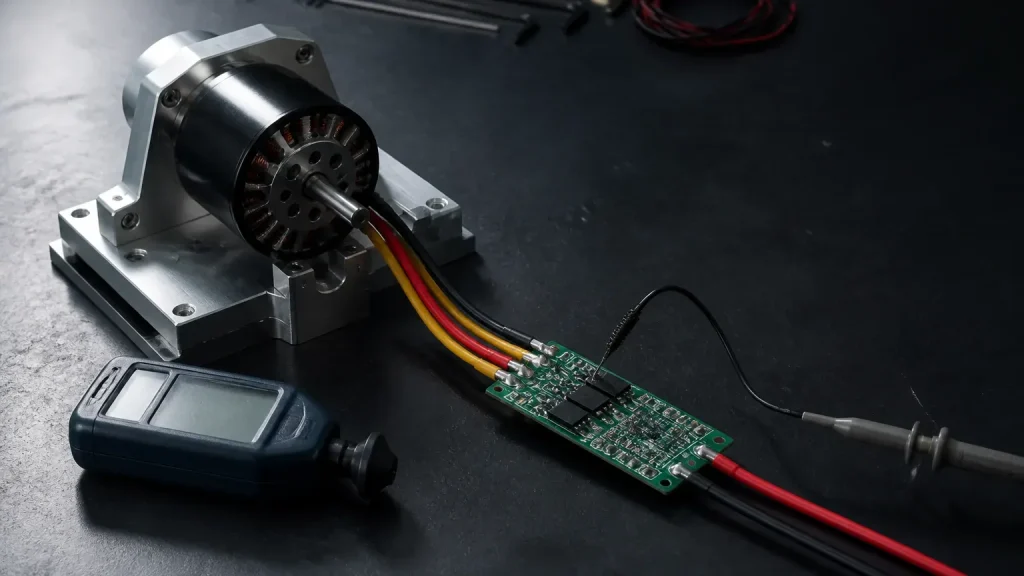
Why a motor loses commutation exactly when current climbs, the six causes in the order worth checking, and a bench routine that makes desync repeatable.
-
 FPV Motor Series Explained: BSC, CM, FS and KONKER
A series name helps you find a motor. It does not finish the selection. ??inematic??is not a payload rating, ??reestyle??is not a battery specification, and ??asic??does not tell…
-
 Drone Motor Bearing Maintenance and Replacement Intervals
A motor that sounds different after a prop strike needs an inspection, even if it is far from its planned service date. A motor that sounds unchanged still…
-
 EEE vs IPE Drone Motors: Weight and Protection
An EEE vs IPE motor decision starts with the conditions the aircraft will face. A lower component mass helps only if the selected version can tolerate the mission.…