


Solid-State Li-Ion vs LiPo for Long-Endurance UAVs
Solid-state Li-ion packs trade peak current for energy density and cycle life. Match chemistry to mission profile before you fix a pack SKU.
A solid state lithium ion drone battery and a high-rate LiPo pack are not interchangeable, even when both fit the same tray. One sells watt-hours and cycles, the other sells amps. This comparison puts both chemistries against what a mission profile actually contains — hover power, usable capacity, pack mass, peak current — so you can choose a side before you commit an airframe.
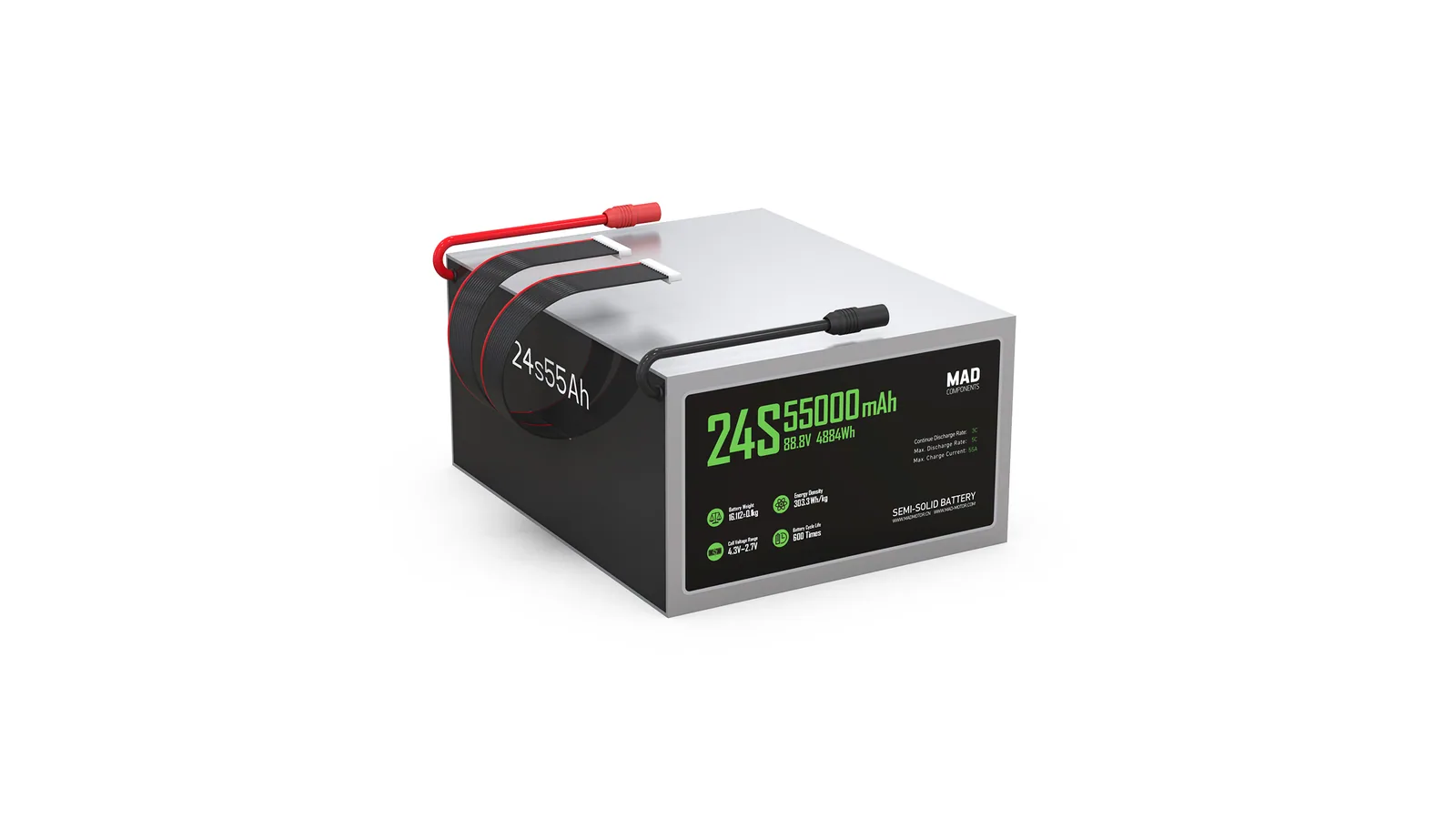
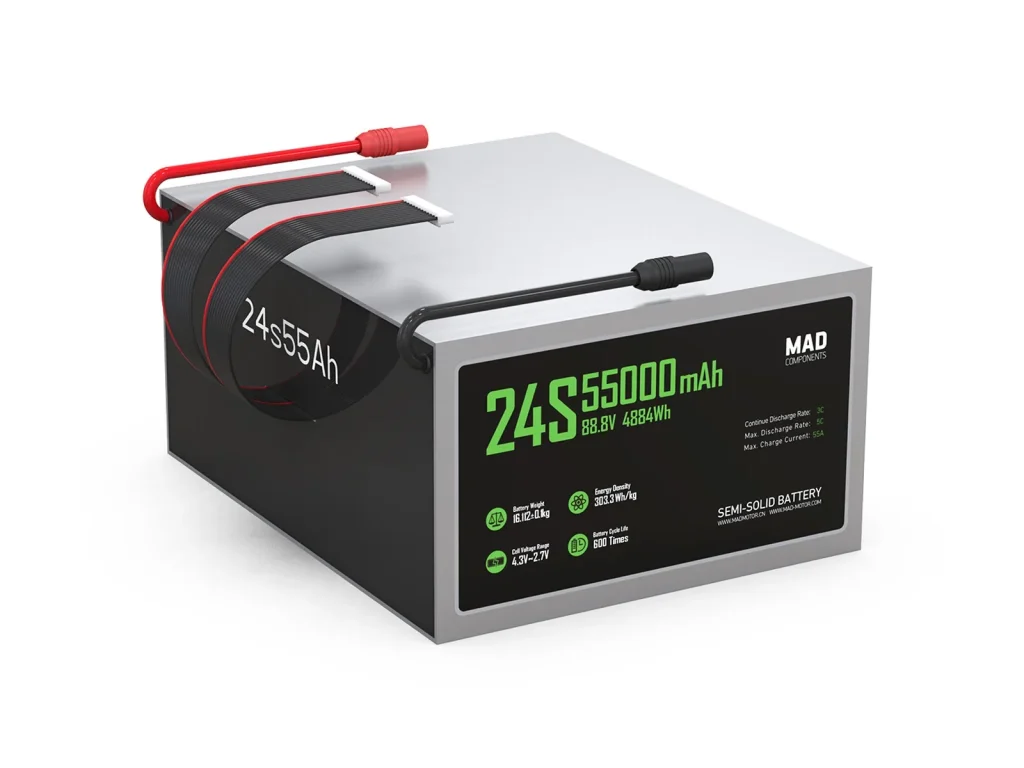
MAD 24S 55Ah pack, 88.8 V / 4,884 Wh, 18.12 kg on the printed label. Hard case, ribbon balance leads and bullet main leads are visible; no internal construction is shown.
TL;DR
- A solid state lithium ion drone battery buys energy density and cycles with discharge headroom: our 24S 55Ah pack is label-rated 3C continuous and 5C peak, not 20C.
- LiPo still wins wherever peak current, crash replacement cost and small airframes matter more than flight time per pack.
- Decide from three mission numbers — hover power, usable watt-hours, pack mass share — then confirm peak current against the label.
Solid-State vs LiPo: Comparison Guide
What does “solid-state” actually say on the label?
On a supplier page, “solid state” is a trade name, not a chemistry specification. The SKU we sell is listed as MAD 24S 55Ah 无人机固态锂离子电池 (SKU 0109DC0169); the printed face of the same unit reads SEMI-SOLID BATTERY.
We keep the vendor wording because buyers search for it, and we state its limit: this article does not infer electrolyte composition and makes no all-solid, liquid-free claim. If your qualification needs the electrolyte class, ask for a cell datasheet and treat the label text as a marketing descriptor until the datasheet says otherwise.
A pack that still ships with ribbon balance leads is a multi-cell series string that needs balancing every cycle, however the electrolyte is described. Plan charger and BMS behaviour from that, not from the word on the casing.
The same wording applies across the REACHSKY drone battery range, from 4S 25Ah to this 24S 55Ah block.
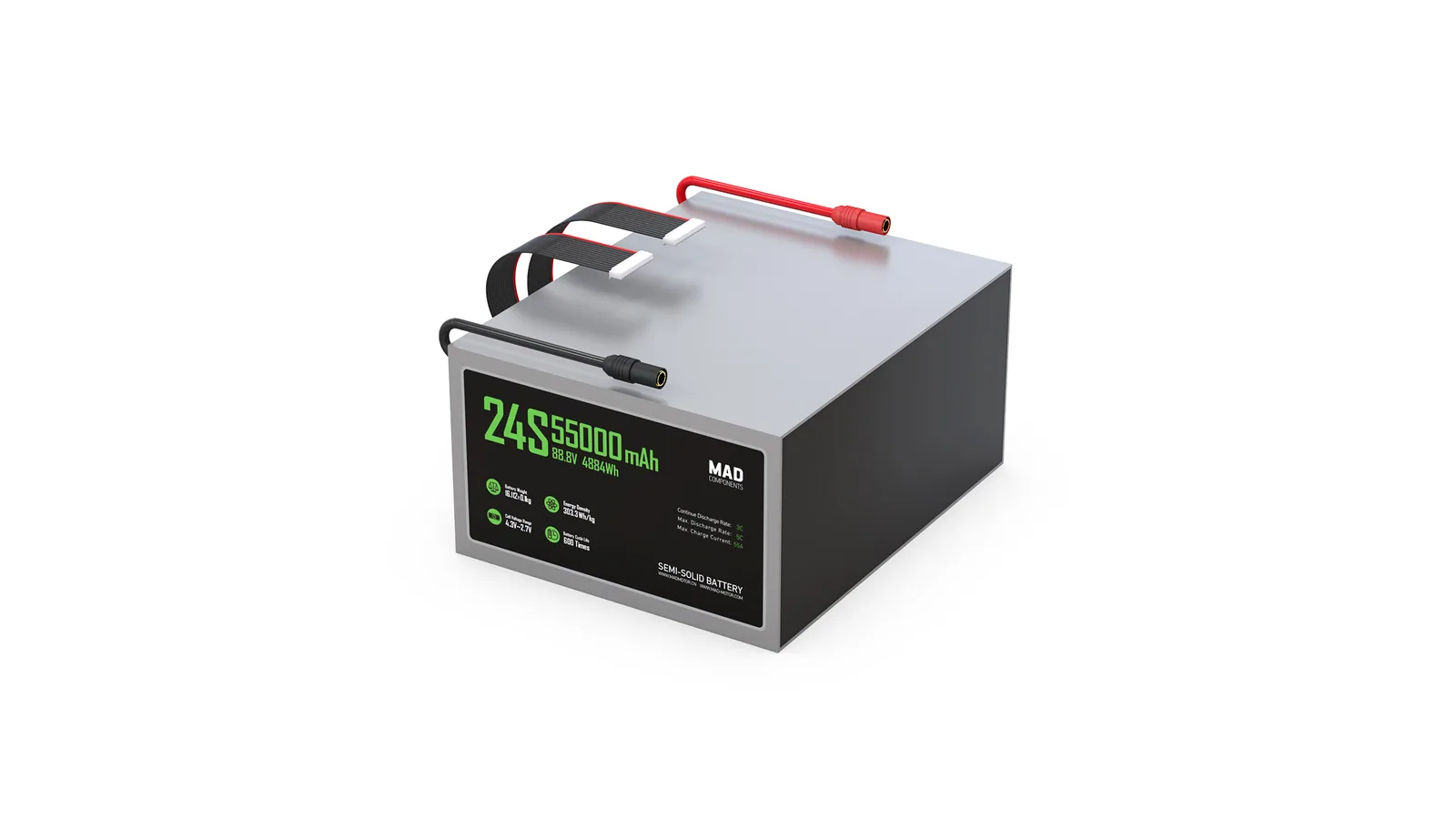
Two ribbon balance leads plus one red and one black main lead exit the top face. Cable count and connector style are what a swap tray has to clear; they say nothing about the electrolyte.
How do the two chemistries differ where it counts?
They differ on six numbers, and only one is energy density. The rest decide whether the pack survives the climb.
The LiPo column describes the general high-rate pouch class, not a named SKU. Confirm each figure against the datasheet you are actually evaluating.
One row hides a cost: a 4.3 V to 2.7 V window only pays off if the charger can be set to those end voltages. On a fixed 4.2 V LiPo profile you leave the top of the capacity unused, then blame the chemistry for the flight time.
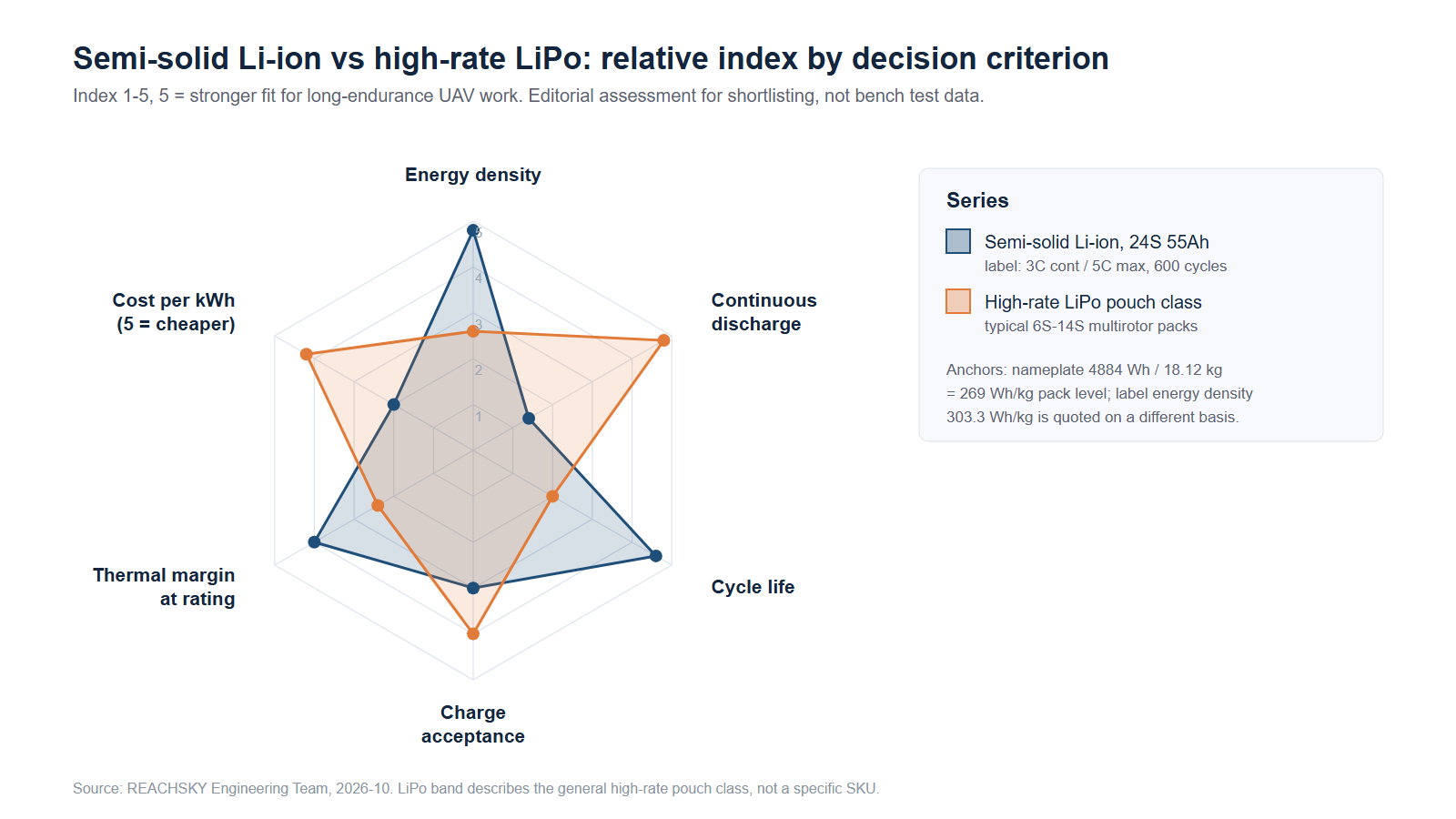
Relative index 1-5, 5 = stronger for long-endurance work. Editorial shortlisting aid, not bench data; anchors are the printed label figures and typical high-rate pouch ranges.
What does the label on the 24S pack actually tell you?
Read the label as working numbers, not marketing: each figure converts into a current, a mass or a flight-minute budget.
Both 269 and 303.3 Wh/kg are printed on the same unit and are not the same measurement. That gap is normal, and it is where most distributor decks go wrong: ask for the basis, cell level or pack level, before the number meets a competitor.
How do you size a pack for a long-endurance mission?
Work backwards from hover power, never forwards from headline capacity. Capacity becomes flight time only after you subtract unusable energy, reserve and the mass penalty the pack adds.
- Take hover power at target all-up weight from a thrust table or flight log, not from the motor’s maximum rating.
- Set usable energy at 80% of nameplate if the pack has to survive hundreds of cycles.
- Flight time in minutes = usable Wh / hover W x 60.
- Add 15-20% for climb, wind and the go-around you will eventually need.
- Check peak current: max thrust current per motor x motor count must stay inside 5C, and sustained climb inside 3C.
On this pack, 3,907 usable Wh gives about 29 minutes at 8 kW of hover power and about 39 minutes at 6 kW. Every extra kilowatt of hover power takes 5-6 minutes off the same pack.
Then check mass share. An 18.12 kg pack inside a 25 kg airframe is 72% of the aircraft, leaving under 7 kg for motors, frame, avionics and payload. At that point the honest answer is usually a lighter pack plus a second one in rotation. Compare voltage, capacity and C-rating classes in our pack selection guide before you design an airframe around one SKU.
Where does LiPo still win?
LiPo still wins on peak current, crash economics and small airframes, and those three cases cover most of the market.
- Peak current. If max-thrust current per motor leaves no margin under 5C, the answer is a high-C pack, not a bigger semi-solid block.
- Crash replacement. A punctured hard case usually means full replacement; a taped pouch stack sometimes means one pack out of a set.
- Small airframes. Below roughly 7 kg all-up, the structural overhead of a hard case eats the energy gain.
- Field charging. 6S LiPo infrastructure is everywhere on a field day; 24S charging is a depot activity.
How do charging and fleet turnaround change?
A 55 A maximum charge current makes this a one-charge-per-hour pack, so turnaround is built on swapping, not fast charging. At about 1C, a deep discharge takes an hour plus balance time; four packs on two 24S-class chargers is a realistic day-one setup, and extra charger capacity usually costs less than extra packs. Storage voltage discipline decides whether the 600-cycle figure survives year two — the rules are the same as for any lithium pack and sit in our battery cycle life guide.
What does it cost per flight hour?
Cost per flight hour, not sticker price, settles this comparison: divide pack cost by cycles times usable kilowatt-hours, and the cycle-life column starts to outweigh the purchase column.
- At 600 cycles against 250, one pack does 2.4 times the flights before replacement.
- Add what a hard-cased pack needs: swap tray, 24S charger capacity, heavier wiring.
Ask any supplier for landed cost per kilowatt-hour and cost per flight hour at your duty cycle. A quote that only states unit price cannot be compared across chemistries.
Procurement notes for distributors and OEM programs
The buying conversation is short if you arrive with the right inputs. These are standard terms on our side, not a special case.
- Samples: one piece is enough to start; evaluation lots ship on the catalogue route.
- Volume: this SKU opens a volume quote from 50 pcs; MOQ beyond that depends on SKU, marking method and packaging.
- Lead time: 3-10 business days for stock replenishment, 7-15 for standard samples, 25-40 for OEM or private-label runs from artwork sign-off and deposit.
- Terms: EXW, FOB, CIF or DDP depending on destination and who handles import.
- Warranty: 12 months standard; claims tie to the PO and production lot and close in writing.
- Documents: ISO 9001 quality system, RoHS and REACH alignment, supplied on request.
Send hover power, all-up weight, target endurance and pack count together and the OEM quote route answers within one business day. Configurations sit on the MAD 24S 55Ah product page.
What about shipping and air compliance?
Treat a 4,884 Wh pack as regulated cargo and let documentation decide the route. Lithium cells fall under dangerous-goods rules for air transport, and the shipper carries the classification responsibility.
Confirm with your forwarder which mode accepts the pack, request the test summary and safety data sheet with the shipment, and expect questions on state of charge, packaging and hazard labelling. We quote no clause numbers here because they change by edition, operator and country; your forwarder’s current edition is the authority. See IATA’s dangerous goods programme and the FAA hazardous materials portal.
No chemistry removes the need for thermal management, charge discipline and cell-level protection. Design the tray so a pack failure is survivable.
Frequently Asked Questions
Is a solid-state drone battery better than LiPo for long endurance? Only when endurance is the binding constraint. At 269 Wh/kg pack level a semi-solid pack carries more watt-hours per kilogram than a typical high-rate LiPo, so it wins on flight time and cycle cost, and loses wherever peak current dominates.
Can a semi-solid pack replace a LiPo on an existing airframe? Usually not without rework. The pack is heavier per unit volume, the window runs to 4.3 V, and the tray has to clear ribbon balance leads and bullet main leads. Check peak current against 5C and confirm charger end voltage first.
What C-rate do I need for a long-endurance multirotor? Sustained climb current plus margin, not burst. Size continuous draw near 3C and keep short peaks inside 5C on a semi-solid pack. High-rate LiPo tolerates far more, which is why transient-heavy profiles still default to it.
How many cycles should I expect from a semi-solid pack? The label states 600 cycles, assuming disciplined storage voltage, moderate charge current and no deep discharges. Treat 600 as an upper bound tied to duty cycle, against 200-300 cycles for high-rate LiPo.
Does a higher energy density pack always increase flight time? No. Flight time is usable watt-hours divided by hover power, and a heavier pack raises hover power. Above roughly 60% pack mass share the extra energy is offset by the structure and thrust needed to carry it.
What information do I need to quote a long-endurance pack? Hover power or all-up weight, target endurance, motor count and KV, maximum thrust current per motor, and pack count per aircraft. With those five inputs we confirm voltage class, C-rate headroom and configuration before quoting MOQ and lead time.
Bottom line
Choose semi-solid Li-ion when flight time per sortie and cycles per pack drive your cost model, and high-rate LiPo when peak current and crash economics do. Convert the label into currents, mass and minutes before you sign a build sheet — this argument is settled by arithmetic, not by the word on the casing.
REACHSKY Engineering Team — propulsion and battery selection support from Changsha, Hunan. We size packs against thrust tables, flight logs and airframe mass budgets, and put the assumptions in writing with every quote.
Last updated: 2026-10-25
All products are supplied for civil end use only.
Related UAV resources: drone battery range, UAV propulsion products, and contact REACHSKY.
相关文章
-
 How to Extend Drone Battery Cycle Life
Storage voltage, charge rate, temperature and depth of discharge decide drone battery cycle life. Here is the routine that keeps a fleet inside the curve.
-
 Battery Charger Selection: 1–14S vs 12–24S
Battery charger selection at a glance The 1–14S charger class spans the widest cell range and the widest channel spread, from single-channel units up to the four-channel SKYRC…
-
 Drone Battery Selection: Voltage, Capacity and C-Rating
TL;DR Drone battery selection comes down to three numbers: pack voltage (series count), capacity in Ah, and C-rating. Set them in that order, because each one constrains the…