


Battery Charger Selection: 1–14S vs 12–24S
Battery charger selection at a glance
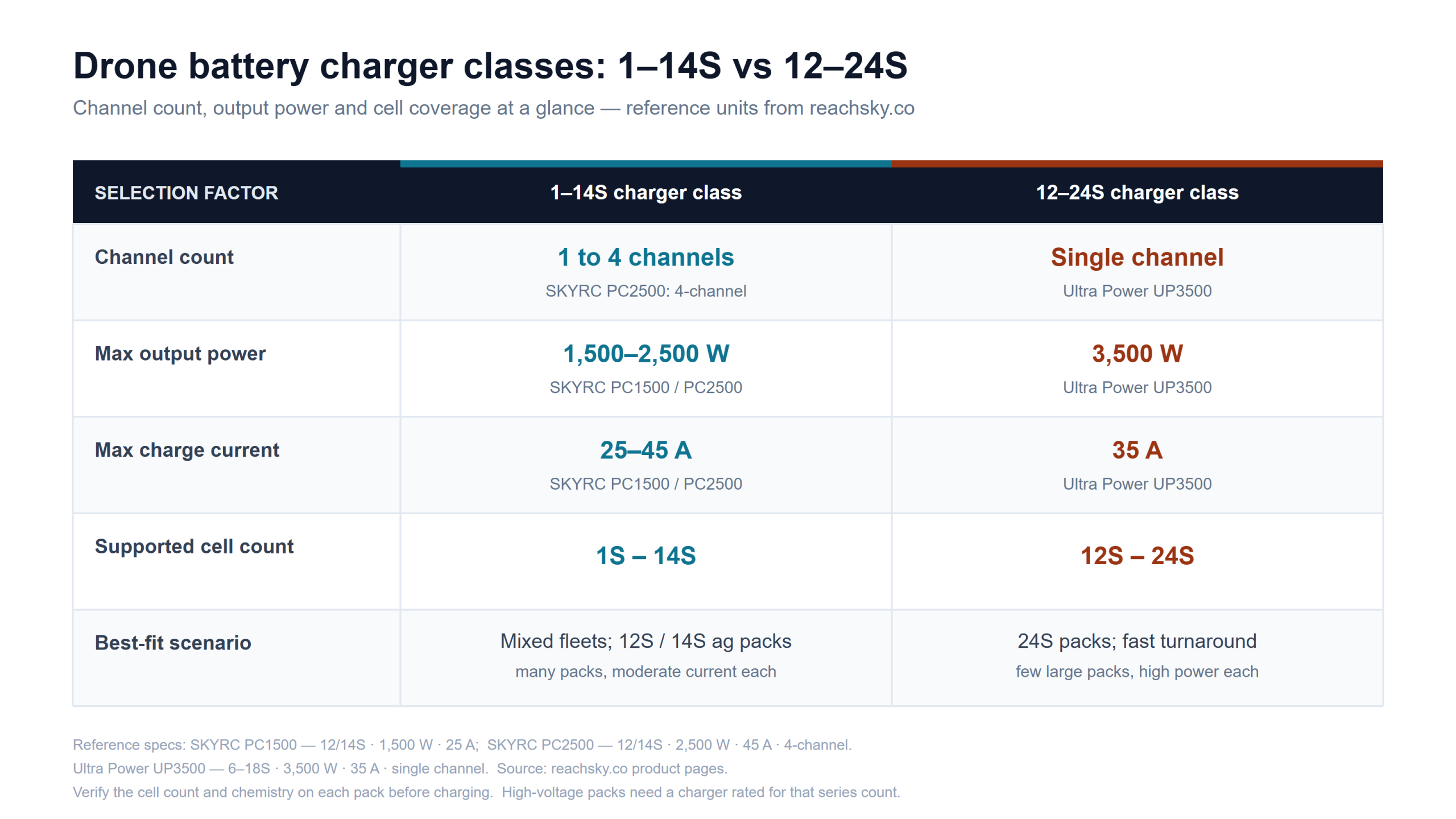
- The 1–14S charger class spans the widest cell range and the widest channel spread, from single-channel units up to the four-channel SKYRC PC2500 (12/14S, 2,500 W, 45 A).
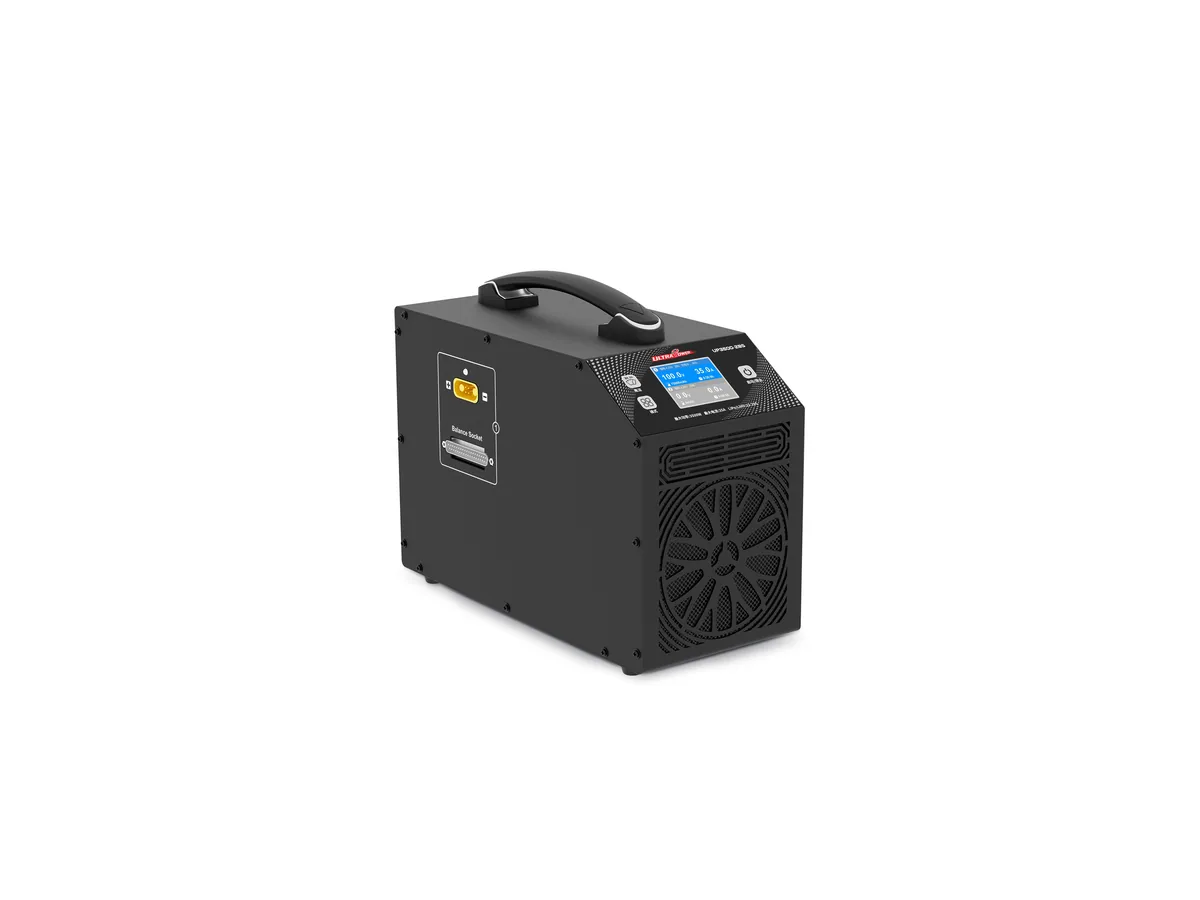
- The 12–24S category is a product range, not a promise that every model supports 24S. The Reachsky UP3500 listing used here is labelled 6–18S, so it must not be presented as a 24S charger without a matching model datasheet.
- Channel count, total output power and the balance-lead layout decide how many packs a fleet turns around per hour — the cell-count rating alone does not.
Introduction
Battery charger selection starts with the pack specification and operating schedule. A pack that has to be ready before the next spray window is a scheduling problem, not a spec-sheet problem. When operators ask us which drone battery charger fits 14S or 24S packs, the answer usually starts with two numbers: how many channels the charger has, and how much power it can send down each one. This guide separates the two charger classes, shows where they overlap, and lists the wiring mistakes that quietly cost turnaround time.
What separates the 1-14S and 12-24S charger classes
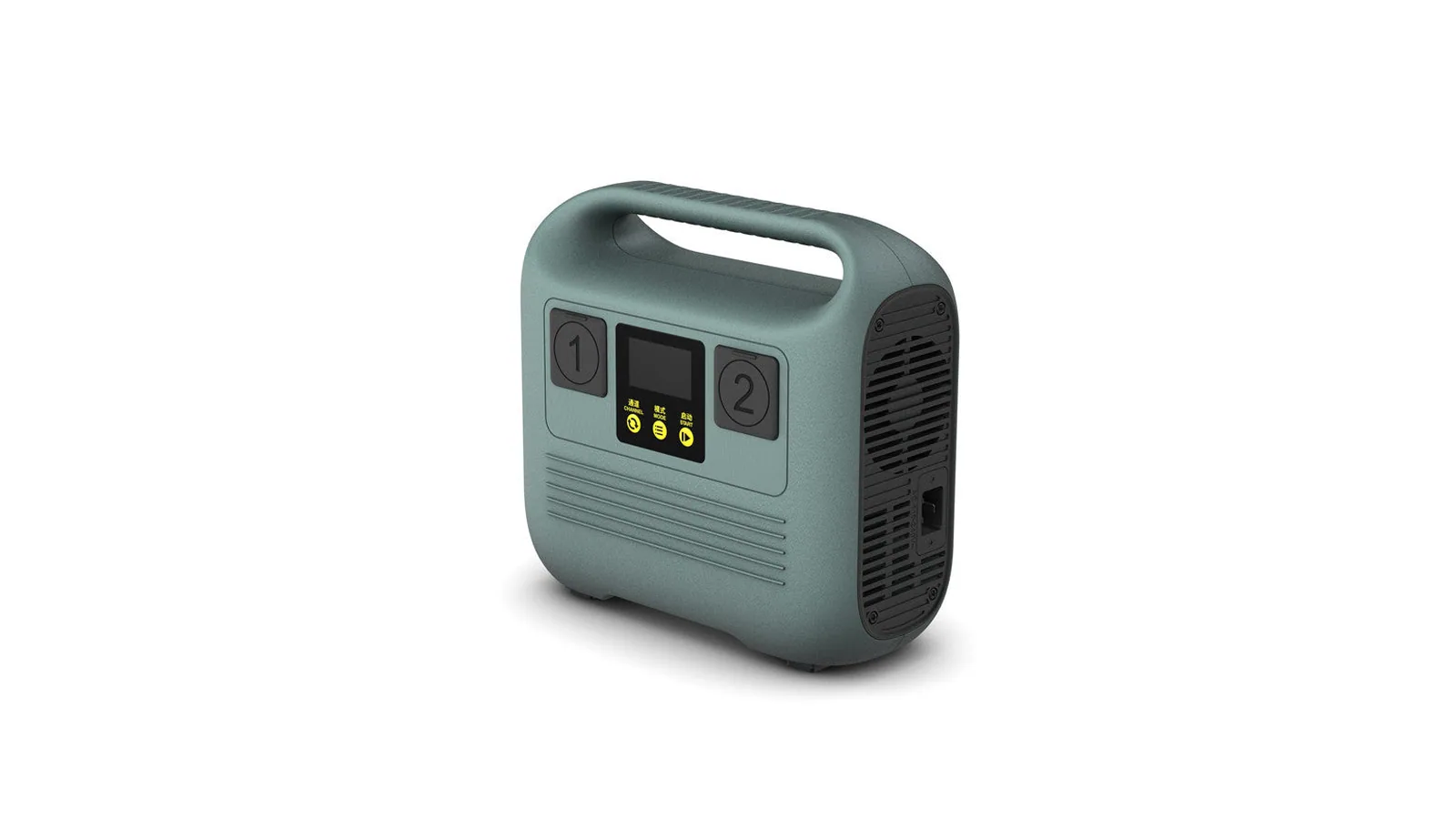
The 1–14S and 12–24S labels describe catalog groups. Confirm the exact charger model, supported series count, chemistry profile, input voltage, output power and channel-sharing rules before ordering. Four specifications decide which class you are actually shopping in.
- Channel count — how many packs charge at the same time. The 1–14S charger range runs from single-channel units up to multi-channel models such as the four-channel SKYRC PC2500. Most high-power chargers in the 12–24S class are single-channel.
- Output power — the total watts the charger can deliver. The 12–24S reference unit, the Ultra Power UP3500, is rated 3,500 W; the 1–14S SKYRC PC1500 and PC2500 sit at 1,500 W and 2,500 W.
- Cell count (series) — the class name is the supported series range. 1–14S chargers cover everything from 1S micro packs to 14S agricultural packs; 12–24S chargers are built for 12S and above.
- Balance wiring — the balance lead, not the main lead, does the cell-level work. A pack with n series cells uses an (n+1)-pin balance connector, so a 24S pack needs more taps than a 12S pack, and the charger’s balance port has to match.
The same 1–14S range also holds smaller AC/DC units aimed at FPV and small multirotors rather than fleets, such as the SKYRC D200neo (1–6S) and the dual-channel HOTA D6 Pro (325 W, 15 A, 1–6S). Those are useful for a two-pack session, but they are not fleet chargers.
One chemistry detail is worth checking before you order. The SKYRC PC2500 lists LiPo at 12S/14S but LiHV at 12S only. Charging a LiHV pack on a LiPo profile, or the reverse, is a common and avoidable failure.
How many channels and how much power does your fleet actually need?
Match the charger to fleet size first, then to pack voltage — a four-channel charger on a 20-pack rotation finishes more packs per hour than a single 3,500 W unit that can only charge one pack at a time.
How many channels and how much power does your fleet actually need?
Practical bands by fleet size:
- 1–4 packs. A dual-channel 1–6S charger covers a small mixed fleet; the SKYRC PC2500 is more charger than the job needs.
- 5–12 packs. A multi-channel charger in the 1–14S class, such as the four-channel 2,500 W PC2500, keeps four packs on charge while the drone flies.
- 12+ packs, high duty cycle. Pair a higher-power single-channel unit with a multi-channel unit: the single-channel charger takes the largest packs quickly, the multi-channel charger absorbs the long tail.
Charging time and turnaround
Charge time is set by pack capacity divided by the usable charge current, and by how many packs share the charger. Three rules keep the estimate honest.
- Wattage is shared across channels. A four-channel charger does not deliver its headline power to every channel at once. The SKYRC PC2500 documentation should be checked for the selected input-voltage mode and channel configuration. Its headline power is a total system rating; do not multiply it by the number of channels.
- The last 20 percent is slow. Lithium-ion chargers taper current in the saturation phase, so the fast bulk phase and the final top-up are not the same speed. Battery University explains why charge current has to drop toward full charge in its notes on charging lithium-ion.
- Fast-charge claims belong to the pack, not the charger. The SKYRC PC2500 product page states that a 12S 16,000 mAh pack can be fully charged in about 15 minutes at 45 A. Treat that as the manufacturer’s fast-charge figure and confirm the pack’s own charge rate before you use it; Battery University covers the limits of fast and ultra-fast charging.
Turnaround then follows from channel count. One 3,500 W single-channel charger and one four-channel 2,500 W charger may move similar total energy, but only the four-channel unit removes four packs from the queue at once.
Which wiring mistakes cause the most failed charges?
Mismatched cell count, mismatched connectors and mismatched balance leads cause most aborted charges, and the first two can damage a pack. Check these five items before the first charge.
- Cell-count or chemistry mismatch. A 12S-rated charger will refuse or under-charge a 14S pack. Confirm the series count and whether the pack is LiPo or LiHV, not just the label on the case.
- Main-connector mismatch. Packs ship with different main connectors such as XT60 and XT90. A rated adapter is fine; a loose or backwards connection is not, even on a charger that claims reverse-polarity protection.
- Balance-lead mismatch. The balance plug’s pin count has to follow the cell count. A lower-count plug can seat in a higher-count port while leaving cells unmonitored.
- Ignoring the pack’s charge rate. Pushing fast-charge current past what the pack accepts adds heat and shortens service life; see Battery University’s notes on cell matching and balancing.
- Missing cable adapters. The site keeps a dedicated charging and balance cable adapter category for exactly this reason.
A 12S–24S (model-dependent) pack puts roughly 44–100 V nominal on the leads. Charge on a non-flammable surface, keep connectors clean and fully seated, never leave a high-power charge unattended, and disconnect the pack when charging is done. Do not open or modify packs.
Buying and compliance for fleet and OEM programs
For fleets and OEM programs a charger is quoted like any other SKU: samples start from one piece, and the real MOQ depends on the SKU, the marking method and the packaging. The terms below are the ones we quote against.
- Samples. From 1 pc.
- MOQ. No fixed floor; batch MOQ depends on SKU, laser marking or label artwork, and packing format.
- Trade terms. EXW / FOB / CIF / DDP, chosen by destination and shipping method.
- Lead time. Stock 3–10 business days; standard samples 7–15 business days; OEM / private-label 25–40 business days from sample approval, artwork sign-off and deposit.
- Warranty. 12 months on standard products unless a quote or datasheet says otherwise; claims are tied to the PO and lot and close out in writing.
- Certifications. ISO 9001 quality system with RoHS- and REACH-aligned processes; documents on request.
- Response time. Sales replies within 1 business day.
On cost structure, we do not publish list pricing, but the step between charger classes tracks three things rather than one: channel-count hardware, the magnetics and cooling needed for higher output power, and whether the unit carries smart-battery features such as CAN communication. The cell-count rating alone is not the main cost driver.
Because the SKYRC and Ultra Power lines come through authorized channels, the model number and label language are locked at order time, so a replacement unit ordered later matches the first shipment.
Sizing a fleet charger for a specific program? Send the pack series count, the number of packs in rotation and the target turnaround. Our engineers return a matched charger list with MOQ and lead time. Request a fleet or OEM quote or grab the technical download pack first.
All products are supplied for civil end use only.
常见问题
Battery charger selection: can a 1-14S charger charge 24S?
No. A 24S pack needs a charger rated for 24 series cells, and the 1–14S class stops at 14S. Charging above the rated series count either gets refused by the charger or stresses the pack. Match the pack’s cell count to the charger’s rated cell window before you connect anything.
What does “1-14S” mean on a charger specification? It is the supported series-cell range. A 1–14S charger can charge packs from a single cell up to 14 cells in series. The figure says nothing about power or channel count, so two 1–14S chargers can differ widely in wattage and how many packs they handle at once.
Is one four-channel charger better than four single-channel chargers?
It depends on the pack and the queue. One four-channel unit shares its total power across channels and takes less bench space, which suits many identical packs charged together. Separate single-channel units give each pack its full rated current at the same time, which suits a few large, high-voltage packs.
Do LiHV packs need a different charger?
Not always, but they need a charger with a LiHV profile. The SKYRC PC2500 supports LiPo at 12S/14S and LiHV at 12S. Charging a LiHV pack on a LiPo cut-off leaves capacity unused, and charging a LiPo pack on a LiHV profile pushes it above its intended voltage.
What balance adapter do I need for a 12S pack?
The balance connector’s pin count is one more than the cell count, so a 12S pack uses a 13-pin balance plug. The charger’s balance port has to match that pin count. If the plug seats but leaves pins unconnected, the charger cannot see every cell, and balancing fails.
How long does it take to charge a 12S 16 Ah pack?
The SKYRC PC2500 product page states a 12S 16,000 mAh pack can be fully charged in about 15 minutes at 45 A. That is the manufacturer’s fast-charge figure for the bulk phase. Confirm the pack’s own charge rate first, because the last part of the cycle tapers and takes longer.
Can the Ultra Power UP3500 charge a 14S pack?
Yes, if the pack sits inside the unit’s rated window. The UP3500 is rated 6–18S, so 14S is within range. It is a single-channel charger, so packs queue one after another; check the main connector and balance lead as well before the first charge.
What is the MOQ and lead time for drone battery chargers?
Samples start from 1 pc, and batch MOQ depends on the SKU, marking method and packaging. Lead time runs 3–10 business days for stock, 7–15 business days for standard samples, and 25–40 business days for OEM or private-label orders after sample approval and deposit.
Choosing between the two charger classes
Pick by the queue, not by the badge. If your fleet runs many 12S/14S packs and you need several packs back in the air at once, the multi-channel, 1–14S class — up to the four-channel SKYRC PC2500 — fits the rotation. If you run a smaller number of high-voltage packs and want maximum power on one pack at a time, the single-channel 12–24S class and the Ultra Power UP3500 fit better. Confirm the series count, chemistry, main connector and balance lead before you commit a charger to a fleet, and tell us the packs you run so we can match the class to your program.
By REACHSKY Engineering Team
Last updated: 2026-10-11
相关文章
-
 Solid-State Li-Ion vs LiPo for Long-Endurance UAVs
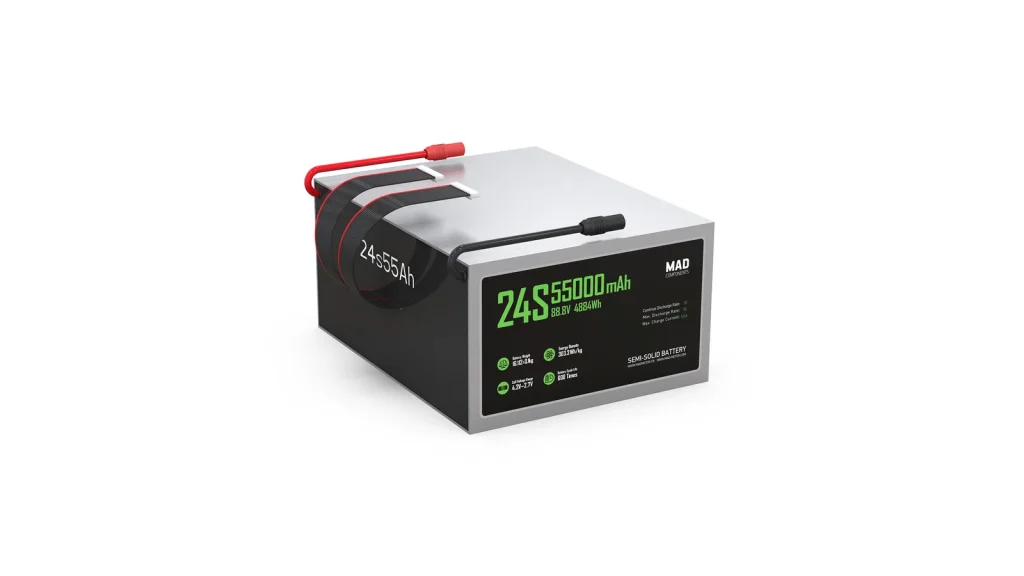
Solid-state Li-ion packs trade peak current for energy density and cycle life. Match chemistry to mission profile before you fix a pack SKU.
-
 How to Extend Drone Battery Cycle Life
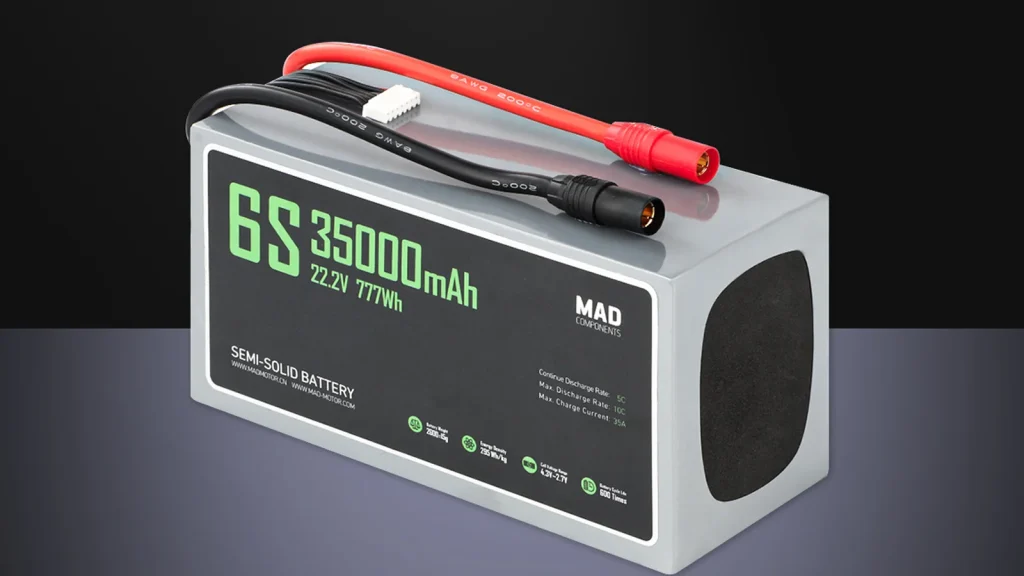
Storage voltage, charge rate, temperature and depth of discharge decide drone battery cycle life. Here is the routine that keeps a fleet inside the curve.
-
 Drone Battery Selection: Voltage, Capacity and C-Rating
TL;DR Drone battery selection comes down to three numbers: pack voltage (series count), capacity in Ah, and C-rating. Set them in that order, because each one constrains the…