


Power System Kit vs Buying Parts Separately
A matched kit trades a higher unit price for one shipment, one owner of the match and less rework. How the four purchase dimensions actually compare.
TL;DR
- A drone power system kit bundles motor, ESC and propeller as one tested set; buying separately buys you a lower unit price and four decisions.
- On a heavy-lift platform the kit premium is often a single-digit percentage, so the decision turns on who owns the match.
- Separate parts suit validated builds and single-part spares; a kit suits new platforms and fixed dates.
Most teams that ask about a drone power system kit versus loose parts compare the wrong line on the quote. Unit price is visible. Matching risk, engineering hours and the number of lead-time clocks you start stay invisible until the first samples reach the bench.
This comparison covers those four dimensions, then closes with a decision table for a sourcing review.
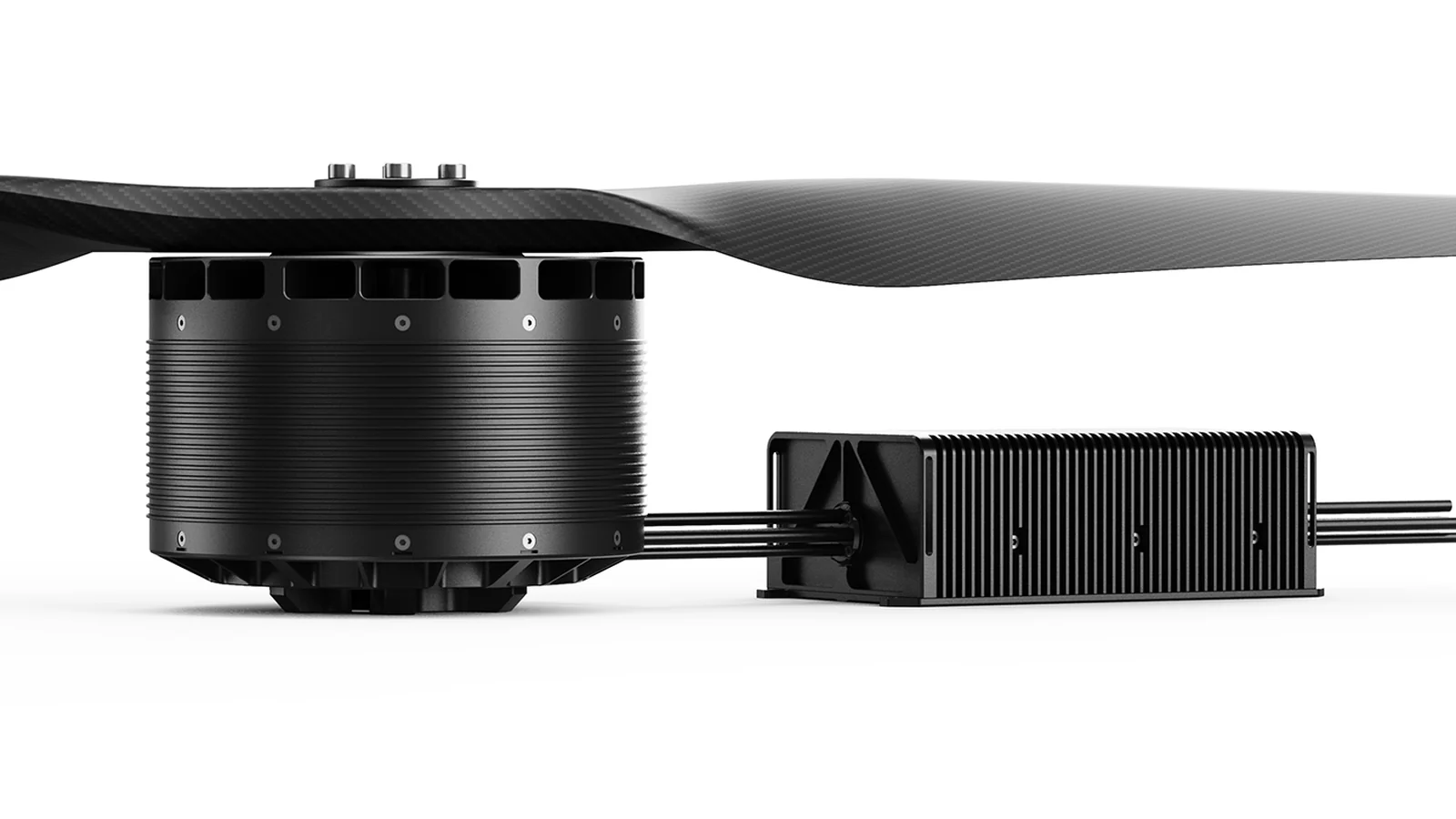
AM110 heavy-lift power system kit, side view. The kit ships as one motor, one 73×29 propeller and one ESC, matched before dispatch.
What is inside a drone power system kit?
A power system kit is a motor, an ESC and a propeller sold as one matched unit, with the interfaces between them already decided. The AM110 heavy-lift power system kit publishes exactly that list: one motor, one ESC, one propeller in 73×29, in CW or CCW rotation.
Two options sit on top. Kit A adds a PT1000 temperature sensor. Kit B adds the sensor plus an encoder that locks the propeller at a specified stop position, which requires compatible ESC firmware.
Buyers underrate the encoder. A stop position is a firmware agreement between ESC and motor; split the purchase across three suppliers and you own that agreement, plus any argument about whose firmware is at fault.
The category also carries coaxial kits and drone arm sets. Packing lists differ by SKU, so read the list before you quote.
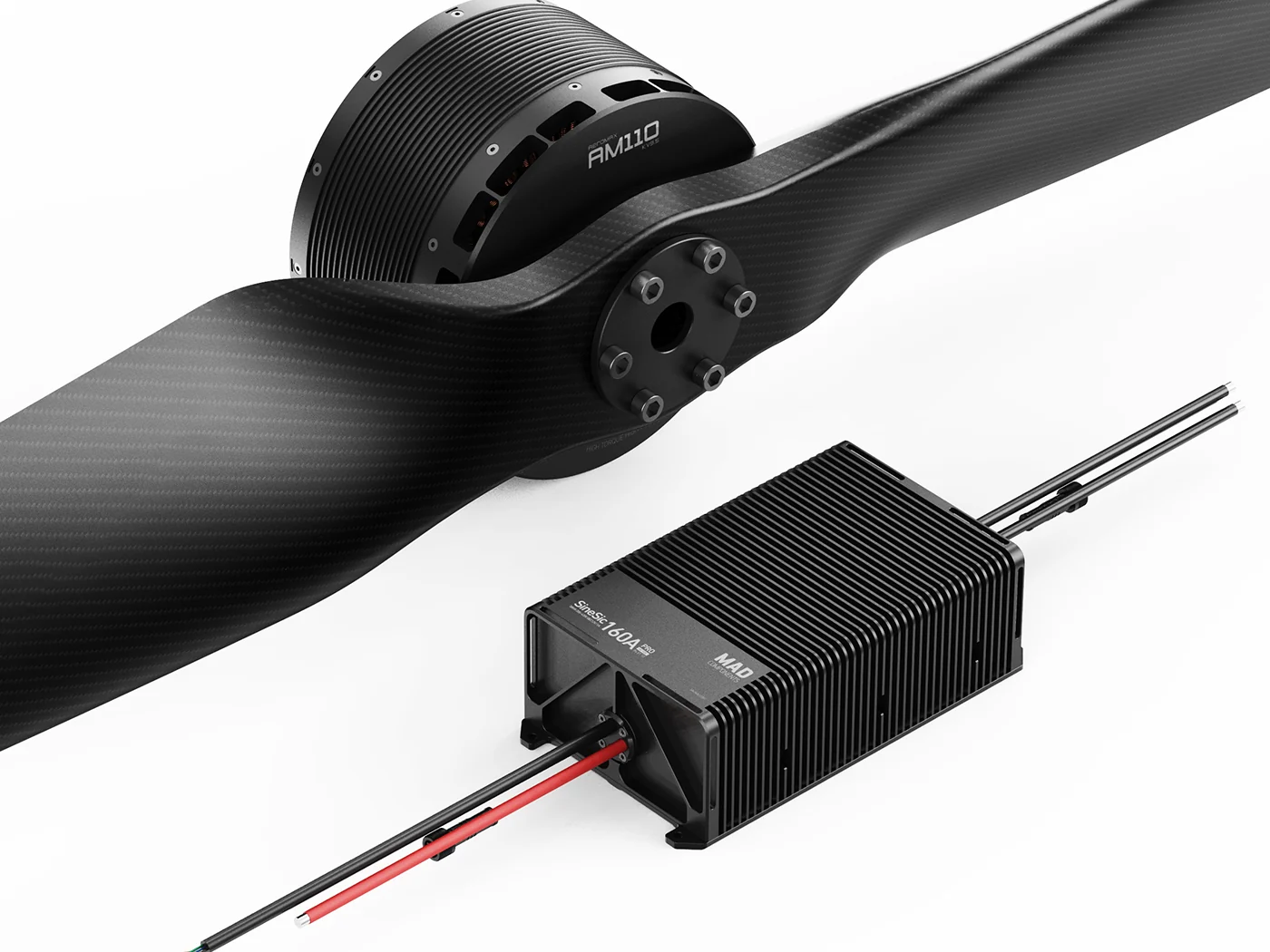
AM110 motor marked AM110, six-bolt propeller hub, and a SineSic 160A Pro ESC labelled MAD. Source: REACHSKY product photography, 2026.
Purchase cost: the premium is smaller than the invoice suggests
A kit costs more per unit because one line item contains three parts plus the matching work. Buying separately gives a lower unit price, and that is its only advantage here.
We compared the AM110 kit listing against its three constituents listed separately — the same motor, a 73×29 propeller and a 160A-class SineSic ESC. The gap came out in the single digits as a percentage of the kit price, not the double-digit premium buyers expect. Prices checked 2026-10-18; we publish structure, not figures.
Four suppliers also mean four MOQ thresholds, four price-increase notices and four packing specs to approve. On a 200-unit build it is a part-time job.
Lead time: one purchase order against four clocks
A kit starts one lead-time clock. Separate buying starts one clock per part, and the order completes only when the slowest one clears.
The published terms set the shape of the comparison:
- In-stock replenishment: 3–10 business days
- Standard samples: 7–15 business days
- OEM or private label: 25–40 business days, from sample sign-off, artwork approval and deposit
Across parts, a stocked propeller and a made-to-order ESC can differ by weeks. If the ESC is the long pole, the prop sits in your warehouse while the schedule slips. Procurement risk compounds: four suppliers, four chances of a stock-out or a missed ship date.
The exception cuts the other way: when one part fails on a flying platform, separate parts let you pull a single motor off the shelf, while a kit makes you wait for the whole set. For fleet operators, that flexibility is worth money.
Matching risk: KV, propeller and ESC have to agree
Matching risk is the probability that the parts behave differently on your airframe than they did on paper. The kit’s advantage is largest here, because the failure modes stay quiet until they are expensive.
Four mismatches account for most of what we see:
- KV against pack voltage. A winding too hot for the pack runs at high RPM and low efficiency. Heat, short flight time and warranty conversations follow. See KV and voltage matching.
- Propeller load against ESC continuous current. Thrust tables are quoted at full throttle; continuous rating is what governs a 40-minute duty cycle. An ESC sized on peak current derates mid-mission.
- Hub and mount interface. Bolt pattern, hub stack height, folding clearance and adapter length are mechanical. A mismatch shows up as runout and vibration, not as an error code.
- Firmware and protocol. PWM, CAN and telemetry conventions differ by ESC family. Encoder stop positions, temperature reporting and throttle calibration all depend on the ESC and motor being designed to talk to each other.
Pitch and diameter are often cast into the blade where nobody looks; read how to read propeller size before comparing part numbers.
A kit removes items 1, 3 and 4 by construction, and usually item 2, because the supplier picked the ESC class around the propeller load. It does not remove your duty to state the duty cycle: a matched set is matched to a stated operating point, not to all of them.
Engineering hours: where the hidden cost sits
Engineering effort never reaches a purchase comparison, and on a new platform it is usually the largest of the four. Buying separately, someone has to read three datasheets in three formats, confirm continuous current against the propeller at your voltage, check bolt pattern and folding clearance against the arm, specify wire lengths and connectors, then bench-check the assembled set and repeat it after any part change.
That list is roughly a week for an experienced team on a familiar platform, more on a first heavy-lift build. A kit collapses it to a packing list, a mounting drawing and one bench check.
The argument gets overstated when your team already validated the combination on a previous build: the kit then sells a service you do not need.
The four dimensions in one view
Cost is the only dimension where separate parts win on paper. The other three move the other way, and they move further the newer your platform is.
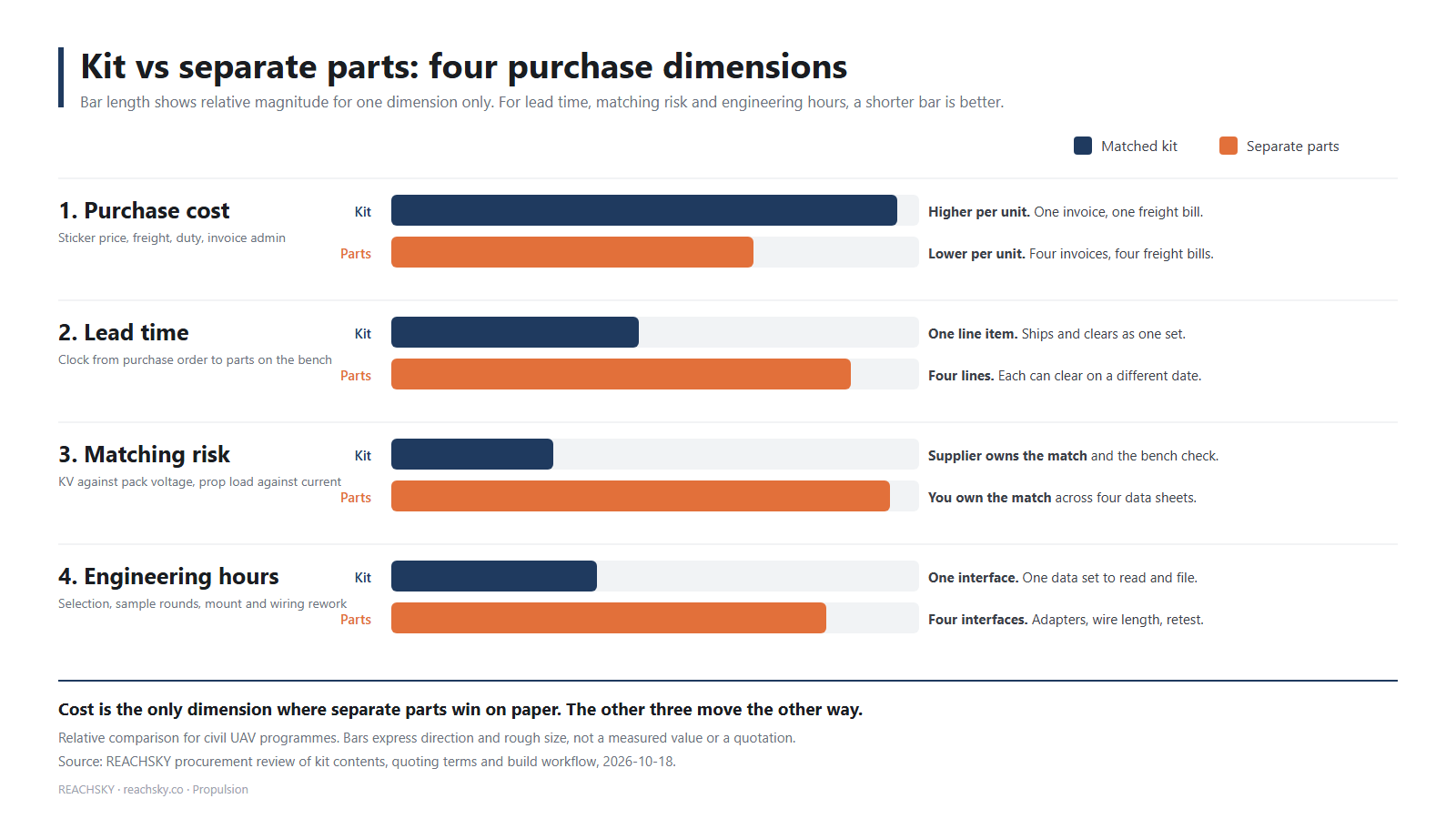
Four-dimension comparison. Bar length shows relative magnitude within a dimension; for lead time, risk and engineering hours, shorter is better.
When should you buy a kit, and when should you buy parts separately?
Buy the kit when the platform is new, the date is fixed, or the parts list is not yet validated. Buy separately when you own a proven combination, need single-part spares, or have a brand requirement no kit satisfies.
The table assumes civil UAV work with a defined payload and duty cycle.
Can one order mix a matched kit with separately branded parts?
Yes. Two supply lines sit behind one order: our own factory and R&D for the parts we develop, and authorised distribution for the brands we carry — MAD, XRotor, Gemfan, HQ Prop, KONKER, FLUXER, Taurus, SineSic, SpeedyBee, DJI, SkyRC and Ultra Power.
That mix matters: a heavy-lift airframe often ends up with a MAD motor and propeller next to a SineSic ESC. One purchase order can carry both, with one packing standard and one shipment.
Kits are configurable rather than fixed: rotation direction, propeller size, temperature sensing and encoder options are chosen at order time, and labelling, wire length and packing notes can be set before the run starts. The constraint is timing.
For the full list, the power system kit and drone arm set catalog carries single kits, coaxial kits and arm sets side by side.
What procurement terms change the comparison?
Four terms move the numbers more than unit price does: MOQ, Incoterms, warranty and claims.
- MOQ. No hard threshold on the line; batch MOQ depends on SKU, marking and packaging. Samples start at 1 pc. On the AM110 kit, volume pricing starts at 50 pcs.
- Terms. EXW, FOB, CIF and DDP, chosen by destination, mode and importer. DDP removes the customs entry from your admin load, which is half of the separate-parts cost advantage.
- Warranty. 12 months on standard products unless the quote says otherwise. Separate parts mean separate warranty clocks and claim owners.
- Claims. Tied to PO and lot, answered within one business day, closed in writing with replacement, credit or corrective action. A single-PO kit keeps one lot reference.
Quality system references are ISO 9001, with RoHS and REACH alignment; documents on request. Programmes that must show a certified QMS upstream can point to ISO 9001. Operators flying in Europe should track EASA’s civil drone rules, which govern end use regardless of how the parts were bought.
Frequently asked questions
Is a power system kit cheaper than buying the parts separately? No. The kit price includes matching, bench verification and single-set logistics, so it costs more per unit. On the AM110 platform the gap is a single-digit percentage.
What is the difference between a power system kit and a drone arm set? Both centre on a motor, ESC and propeller. The packing list defines the difference and varies by SKU, so read the product page before quoting.
Can I mix brands in one order? Yes. Matched kits and branded parts can ship on one purchase order, one packing standard, one shipment. State the combination and interface requirements in the inquiry.
How long does a kit take compared with separate parts? In-stock 3–10 business days, samples 7–15, OEM or private label 25–40 from sign-off. Separate parts start one clock each and complete at the slowest.
When is buying separately the better engineering decision? When the combination is proven on a flying platform, when spares must be replaceable one at a time, or when a brand is mandated.
Next step
If the platform is new, send the airframe spec before you split the order into four. We confirm the KV band against your pack voltage, size the ESC against the propeller at your duty cycle, and quote kit and separate parts on one sheet.
Send your platform spec for a matched kit quote — include AUW, pack voltage, propeller diameter and duty cycle. If you already know the part numbers, the current stock list is faster.
If you would rather start from a matched set, see how to choose a heavy lift power combo around payload and hover time.
REACHSKY Engineering Team Motor, ESC and propeller matching for civil UAV programmes. Changsha, China. ISO 9001 quality system; RoHS and REACH alignment.
Last updated: 2026-10-18
All products are supplied for civil end use only.
Related articles
-
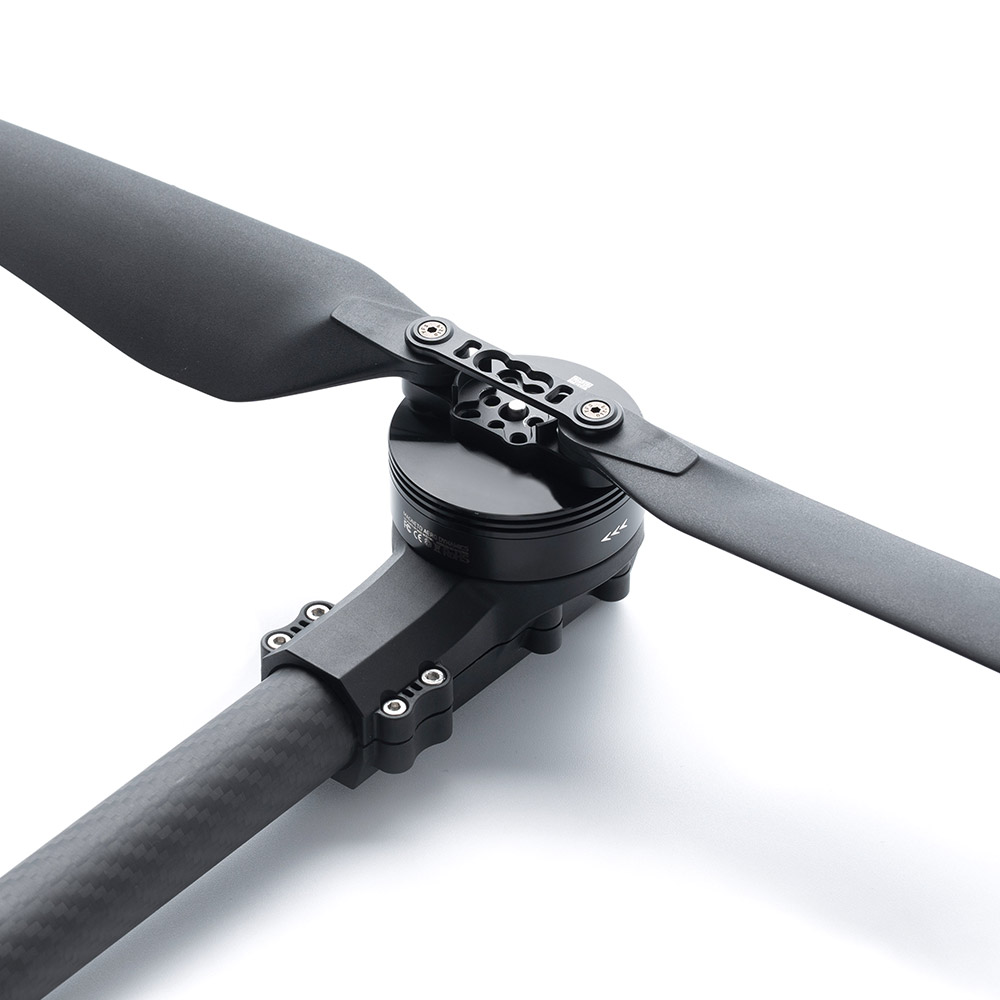 Integrated FOC Arm Sets: Why KV and Prop Size Are Fixed
A replacement motor bolts onto the arm. The propeller clears the frame. The connector fits. None of those checks confirms that the original controller setup still applies. An…
-
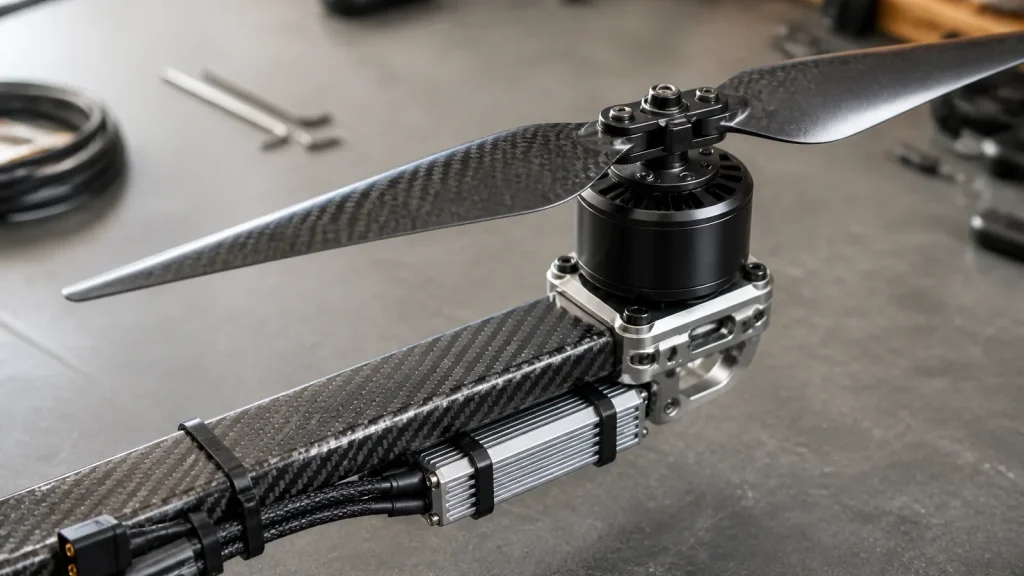 Heavy Lift Power Combo: How to Choose One for a New Airframe
Payload and hover time first, then thrust per arm, prop diameter, KV ceiling, ESC current and pack count. A worked 50 kg hexacopter example.