



Drone Parts Lead Time: Stock, Samples and OEM Explained
Stock, sample and OEM orders start their clocks on different events. Map each track, buffer the critical path and give suppliers a real ship window.
TL;DR
- A drone parts lead time is three different windows, not one: stock 3–10 business days, standard sample 7–15, OEM or private label 25–40.
- Each window starts on a different event. Stock starts at allocation, a sample starts at a written spec, an OEM batch starts only when sample approval, artwork sign-off and deposit are all in place.
- The number that ruins a build plan is almost never the production window. It is a late approval, a spec change after deposit, or transit treated as if it were part of the quoted lead time.
A drone parts lead time is the working window between a confirmed order and handover to the carrier, and it splits into three tracks with different clocks. Read this before you promise a ship date to a customer or a build date to your assembly team. You will get the stage-by-stage breakdown for stock, sample and OEM orders, the triggers that add weeks, and a backward-planning method you can put into a purchase order. Most delays we see are not production problems. They are calendar problems: a PO released three days before a public holiday, an artwork proof that needs a second round, a deposit that arrives before the PO number does. None of those appear in a quoted lead time, and all of them move the ship date.
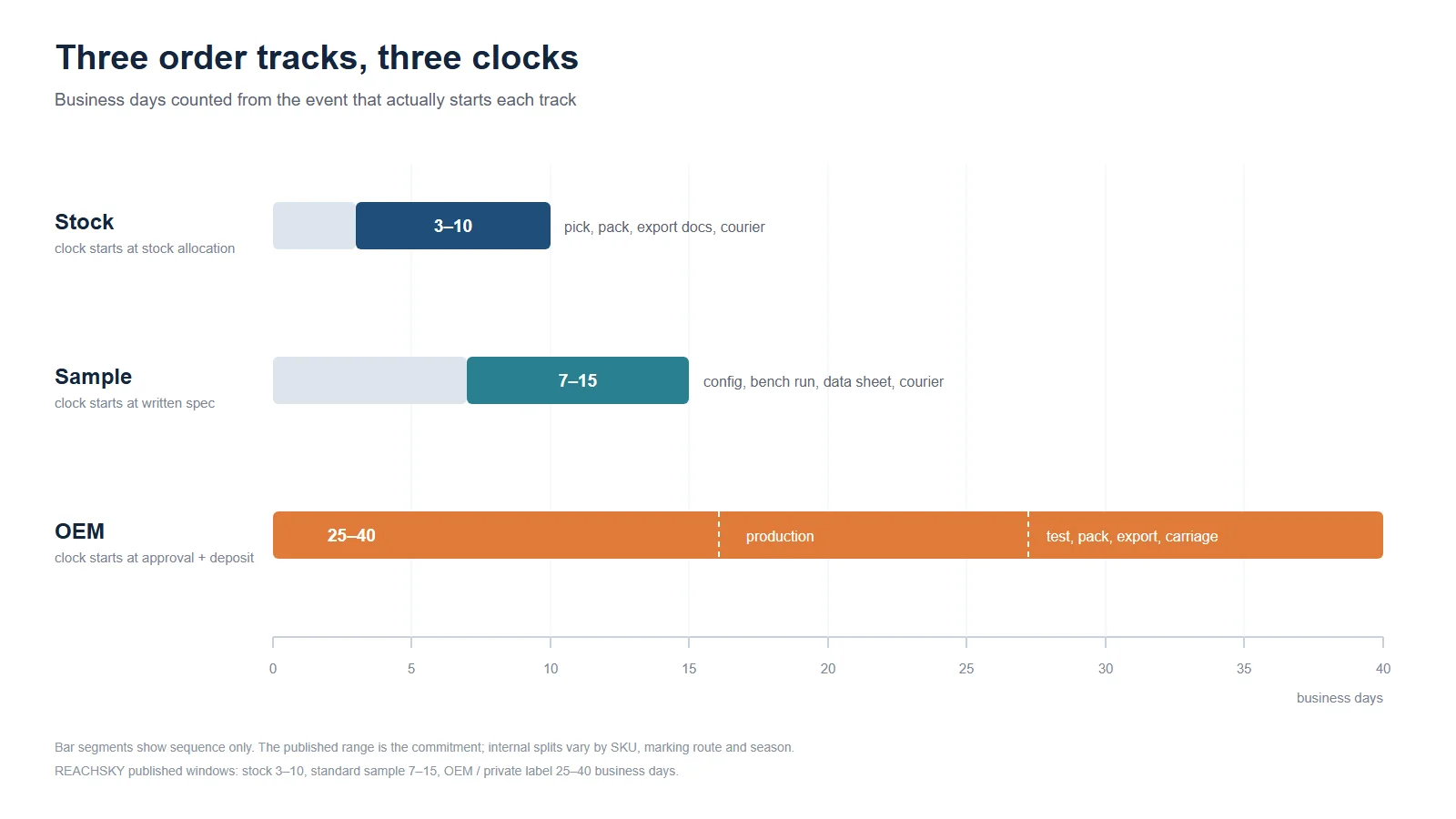
The three tracks are plotted against the same axis on purpose: a 25–40 day OEM window is not a slow stock order, it is a different process with a different starting event.
Drone parts lead time: three tracks, and the clock starts at a different event on each
The starting event matters more than the number attached to it. A stock window is measured from the moment stock is allocated to your order. A sample window is measured from the moment the configuration is confirmed in writing. An OEM window is measured from the moment three separate conditions are true at once: sample approved, artwork signed off, deposit received. That last point causes most of the confusion in first OEM projects. Buyers add the sample window to the OEM window and assume the total is the project length, then discover the approval loop between them was never counted.
The catalog behind those windows spans 633 SKUs across eight product lines, from an entry-level FPV propeller to an AM160-class heavy-lift kit, two orders of magnitude apart in price and in handling. A 78-inch FLUXER PRO prop and a 12S flight controller do not move through the same handling steps, so no single lead time describes both.
What fills the days on a stock order?
A stock order is short because nothing is manufactured. The 3–10 business days are consumed by allocation, picking, a quality spot check, export paperwork and the courier handover, in that order. Manufacturing time is zero; queue time is not. The window assumes the SKU is on the shelf when the order lands. If it is not, the order stops being a stock order: it becomes a replenishment order, the clock restarts, and the date you were given is no longer valid. That is the most common reason a buyer says “you quoted 3–10 days and it took five weeks” — the part was never in the 3–10 day category on the day of purchase. A cut-off effect sits inside the window. An order that clears before the daily picking cut-off starts the same day; one that clears after it starts the next working day. Two orders placed an hour apart can ship a day apart. What you can do inside this track:
- Confirm the SKU and pack size. A “pair” and a “set of four” are different line items.
- Put consignee name, address, phone and tax or import number in the PO, not in an email after the invoice.
- Ask whether the stock figure is live or indicative, and keep a second approved SKU for anything that blocks assembly.
What happens during a sample order?
A sample order takes 7–15 business days because it is a configured build, not a shelf pick. The unit is pulled and checked against your specification, the bench run produces a data sheet, and the parcel goes out through the same export desk as any other shipment. It is short, but it is not instant, and it is not a miniature production run. The window starts at a written spec. In practice that means the model, the KV, the propeller pairing, the connector type, the firmware version if the SKU is programmable, and whether the sample carries any marking. Send those in the first message and the sample slot can be booked immediately. Send them across four emails and the 7–15 days start whenever the last one arrives. Bench data is the part worth waiting for. Our in-house bench records thrust, current, input power, throttle position and efficiency, so you can check a motor against the propeller you actually intend to fly rather than the one in the catalog table. Two limits are worth stating plainly. A sample proves fit, interface and baseline data for one configuration. It does not prove batch consistency, which is a production control question answered by inspection and sampling during the OEM run, and it does not reserve capacity — the OEM deposit books the slot.
Where OEM orders lose weeks
OEM and private-label orders run 25–40 business days, counted from the later of sample approval, artwork sign-off and deposit. The work inside that window is real: component purchase orders and incoming inspection, marking programs, label and carton production, batch assembly, burn-in, sampling, certificate pack, and export booking. The three-condition rule is where projects slip. If the sample is approved on the 2nd, the artwork is signed on the 9th and the deposit lands on the 6th, the clock starts on the 9th. Suppliers usually say “from approval and deposit” and buyers hear “from approval”. Put the rule in the PO so nobody has to renegotiate it in week three. Marking and packaging are the quiet schedule risk, not the parts. Laser marking needs a program and a first-article check; labels need language, barcode and warning content fixed; cartons need a dieline and a print run. Each is a small project with its own proof cycle. The options are a separate decision — marking, labels and packaging for OEM orders covers the choices, while this article only counts the time they consume. Component supply is the second risk. A batch of heavy-lift motors is gated by whichever input arrives last: housings, magnet grade, bearings, connectors, or the ESC board for a matched kit. A kit such as the HB110 or an XH14 coaxial arm set has more of those inputs than a single motor, so it has more ways to wait. Ask at quote stage which component is the long pole and whether an approved alternate exists. The 25–40 day range is wide because the variables are wide. A repeat order with an existing marking program and components in stock sits near the bottom; a first article with new artwork, a new carton and a component on allocation sits near the top. Same supplier, same motor family, different position in the range.
Where drone parts lead times slip: eight triggers
Most slippage comes from eight recurring triggers, and seven of them are visible before the deposit is paid. The table below pairs each trigger with the first symptom you will see and the control that prevents it.
The eighth trigger is internal to the buyer and harder to see: approval authority. If the person who signs the artwork is on leave, the OEM clock does not start, and no amount of supplier pressure recovers those days. Holidays are the eighth trigger, and the calendar carries them whether or not the window does. China’s National Day week and the Lunar New Year period remove production and logistics days that a 25–40 business day window does not absorb. If your ship date is fixed, mark the closure weeks before you choose a deposit date.
How do you put a lead time into a purchase plan?
Build the plan backwards from the ship date, not forwards from the PO. Take the date the goods must leave the factory, subtract the production window at its upper bound, subtract the approval days you actually need, and the result is the latest date you can release the deposit. That number, not the lead time, is the one to put in front of your team. The arithmetic is simple and it is the part most plans skip:
- Fix the ship date and the transport mode.
- Subtract the upper bound of the production window, not the midpoint.
- Subtract the approval loop: sample review, artwork sign-off, internal purchase approval.
- Subtract one buffer for the whole chain, not one per stage.
- The result is your deposit deadline. Anything later is a risk you have chosen to accept.
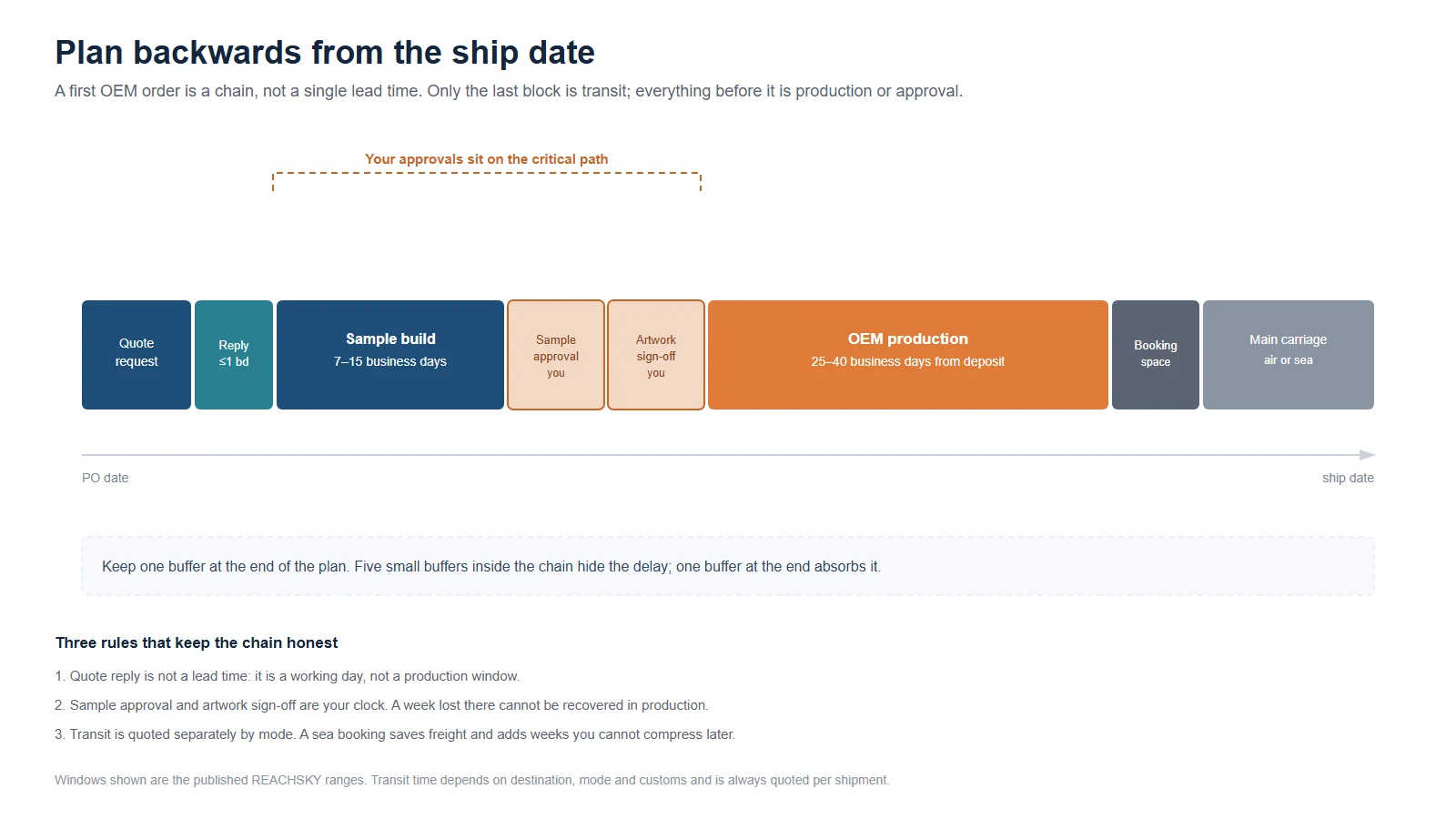
Approval blocks are drawn in orange because they belong to the buyer. A week lost in sign-off moves the ship date one week; a week lost inside production usually does not. Two worked examples, using published windows and an illustrative 30-day door-to-door sea transit:
- Sea freight, first OEM order: 40 business days of production plus about 30 calendar days of transit plus a 5-day buffer puts the deposit roughly eleven weeks before the goods are needed. Release it late and the only lever left is air freight.
- Air freight, repeat order: production near the lower bound plus a few days of transit puts the deposit four to five weeks out. The premium buys schedule certainty, not a shorter production window.
Milestones beat a single promise. Ask for four dates instead of one: component availability, production start, test completion and carrier handover. A slipped milestone is a warning you can act on; a slipped ship date is a fact you can only explain to a customer.
What does expediting really cost?
Expediting buys position in a queue or a faster mode; it does not shorten the physics of winding, assembly or test. The realistic options are a faster transport mode, a split shipment, a queue jump, a simpler configuration, or a substitute SKU — and each has a different cost structure. Air versus sea. Air freight is billed on chargeable weight, the greater of actual and volumetric weight. Propellers and arm sets are bulky, so a carton of large props can bill at several times its physical mass. Flying a low-value, high-volume item is often irrational; flying one critical ESC to unblock an assembly line usually is not. Split shipment. Send the twenty percent that unblocks assembly by air and the balance by sea. You pay the premium on the part that matters and keep the rest at standard freight. This is usually the cheapest way to protect a launch date. Queue jump. Moving a batch forward means another order moves back, so the premium pays for displaced capacity rather than extra work. Worth it for a customer contract or a field trial; wasteful for a self-imposed date. Simpler configuration. Dropping private-label marking and shipping neutral removes the artwork and label cycle from the critical path. On a first order that can save more calendar time than any freight upgrade, at the cost of shelf presentation rather than cash. Substitute SKU. An in-stock KV or a different propeller size can cover the gap, but only if the propulsion set is re-checked. Change one element of a matched motor, ESC and prop combination and you have to re-verify current draw and thrust — the four inputs that make a matched quote fast are covered in how to get a matched propulsion quote. What we will not do is compress test. Burn-in and sampling are the only stages that catch a batch defect before it reaches your customers, and a batch that ships untested is not faster, it is just earlier and worse. For buyers weighing a cart checkout against a quoted order, the split is straightforward: checkout suits known SKUs inside published pack sizes, while a quote suits mixed carts, staged deliveries and engineering review. The comparison is set out in “请求报价”与“结账”.
Quote time, production time and transit are three different promises
A one-business-day reply is a response commitment, not a production commitment. Quotes return within one business day when quantity, destination and target ship window are in the first message; that speed says nothing about how fast goods move, and production starts at deposit. Transit begins at handover and depends on mode, destination and customs. Incoterms decide where that handover happens, and a DDP order carries more work than the same goods under Incoterms 2020 FOB. ISO 9001, RoHS and REACH documents run on a parallel clock: the REACH regulation 以及 RoHS directive define what those declarations cover, so flag a distributor certificate request at inquiry stage.
常见问题
How long does a drone parts order take to ship? In-stock items ship in 3–10 business days, standard samples in 7–15, and OEM or private-label batches in 25–40. Transit is additional and depends on mode and destination. Does the quoted lead time include shipping? No. The published windows end at handover to the carrier. Ask for the transit quote separately, then add it to the production window before you commit to a delivery date. When does the OEM clock actually start? It starts on the latest of three events: sample approval, artwork sign-off and deposit received. If artwork is signed five days after the deposit, production starts five days later than the buyer expects. Can an OEM order be delivered faster than 25 business days? Sometimes, by removing work rather than compressing it: neutral packing instead of private label, an existing marking program, or a split shipment. Test and sampling are not shortened. Can I order one sample before committing to a batch? Yes. Sample orders start at one piece, and the sample is the normal way to confirm fit, connector and bench data before an OEM deposit. A sample does not reserve production capacity. What information gets an accurate lead time in the first reply? Quantity, destination country, target ship window, and whether the order needs marking or private-label packaging. Those four decide which track applies and where in the range the order sits.
Plan the calendar, then buy the parts
The useful number is not a lead time but a date: the day your deposit has to clear for the goods to leave on time. Work backwards from the ship date, use the upper bound of the window, keep one buffer, and track milestones. For an OEM or private-label order, send the quantity, destination and target ship window with your configuration and we will return the applicable window and start conditions in writing. Start with OEM programs and sample orders 或 request a B2B quote. If you are still comparing hardware, the power system kit and drone arm set range shows what a matched set looks like before it becomes a production item. All products are supplied for civil end use only.
REACHSKY Engineering Team writes from the factory floor in Changsha, Hunan, where we have built and shipped UAV propulsion components for 12 years. Our engineers run in-house bench tests on thrust, current and efficiency, and support OEM programs through ISO 9001 processes with RoHS and REACH alignment. Last updated: 2026-10-31
相关文章
-
 Three Blade vs Two Blade Propeller: Heavy-Lift Trade-Offs
One extra blade at the same diameter buys thrust margin and a lower hover RPM, and costs current, peak efficiency and stowed volume. Here is when it pays.
-
 Falcon vs Voyager Propellers for Fixed-Wing UAVs
A fixed-wing propeller shortlist often starts with a diameter limit. The nose, landing gear or pusher installation leaves room for a particular disc, and the buyer searches within…
-
 How to Handle a Warranty Claim on Motors and ESCs
“The motor stopped” describes a symptom. It does not identify the delivered part, show the conditions before the event or explain what happened afterward. That is why a…
-
 CW vs CCW Propellers: Avoiding Mix-Ups in Dealer Kits
A box can contain the right diameter, the right pitch and the right number of propellers, yet still be wrong for the aircraft. The missing check is handedness.…